European Pied Flycatcher
The European pied flycatcher (Ficedula hypoleuca) is a bold black-and-white migrant, a nest-box favorite among researchers, and one of the most closely studied songbirds for how climate change is disrupting migration timing.
Key facts
- Latin name
- Ficedula hypoleuca
- Wingspan
- 21.5–24.5 cm
- Season
- April – September, wintering in West Africa
- Diet
- Flying insects, caught in short aerial sallies from a perch, Caterpillars gleaned from foliage, especially for nestlings, Spiders and other invertebrates
- Conservation status
- LCLeast Concern
Appearance
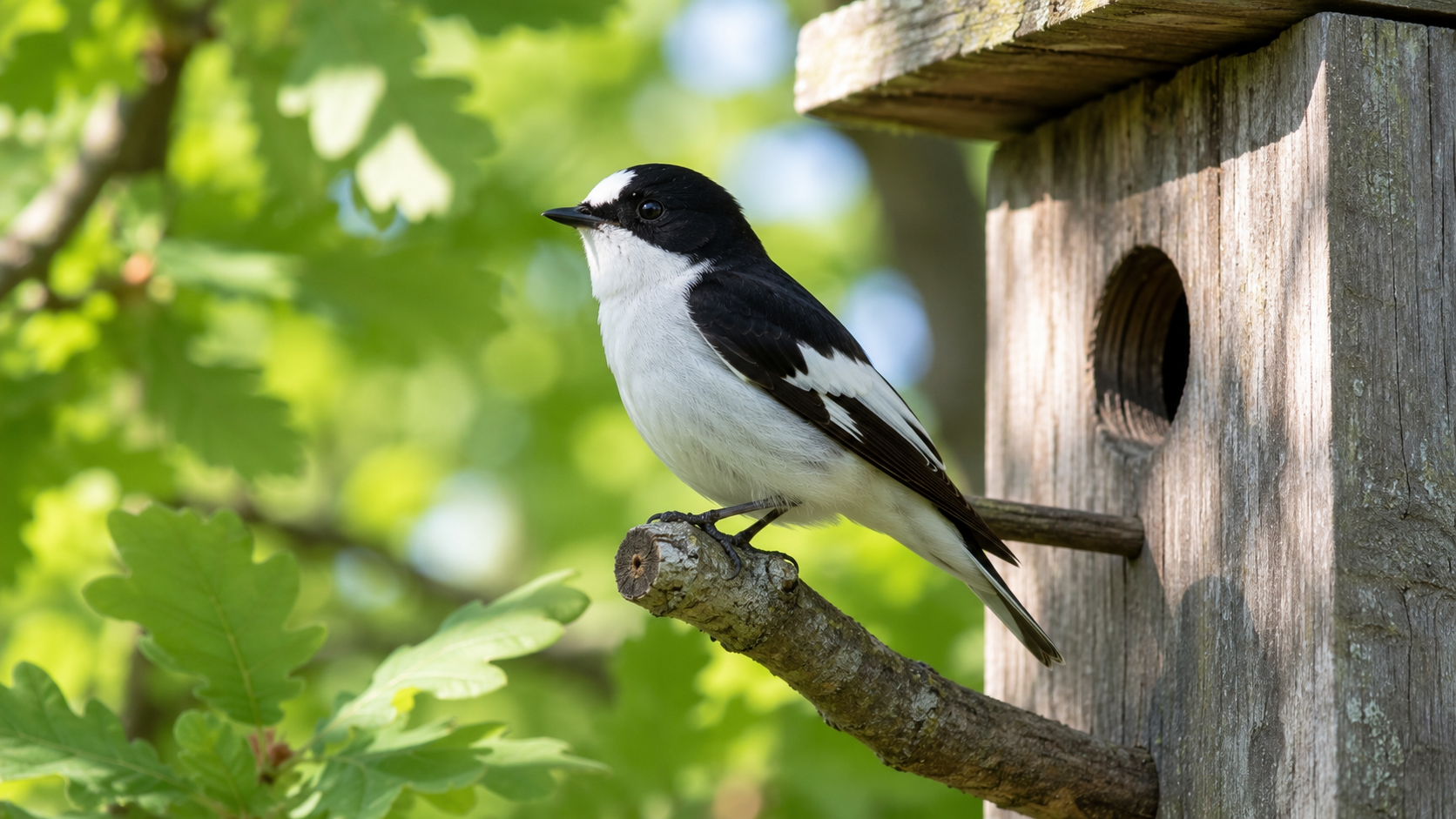
The European pied flycatcher (Ficedula hypoleuca) is a small, compact songbird with a wingspan of 21.5 to 24.5 cm and a body length of about 12 to 13.5 cm, weighing between roughly 12 and 15 grams. The breeding male is boldly and crisply patterned: black upperparts, a bright white patch on the forehead, a conspicuous white patch on the folded wing, and pure white underparts, giving a striking, high-contrast appearance that stands out clearly against green spring foliage.
Females and non-breeding males look considerably plainer, with the black replaced by a more muted grey-brown, though both retain the same basic white wing patch and pale underparts pattern in reduced form. The beak is broad and slightly flattened at the base, an adaptation shared across the flycatcher family for efficiently snapping up flying insects caught in mid-air.
Range and habitat
The European pied flycatcher breeds across much of Europe and extends into western Russia, generally favoring mature deciduous woodland, particularly oak-dominated forest, though it also occurs in parks and large gardens with suitable old trees. It is a long-distance migrant, present on the breeding grounds from roughly April to September and wintering in West Africa, one of the longer migratory journeys undertaken by any small European songbird covered in this atlas.
As a cavity-nesting species dependent on tree holes, its local breeding distribution is closely tied to the availability of mature trees with existing cavities, often originally created by woodpeckers, or to artificial nest boxes, which the species accepts with particular readiness.
Behavior and lifestyle
True to its name, the pied flycatcher hunts primarily by sallying — making short, quick aerial dashes from an exposed perch to snatch a flying insect directly out of the air before returning to the same or a nearby perch — though it also readily gleans caterpillars and other invertebrates directly from foliage, particularly important when feeding a demanding brood of nestlings.
The species' breeding timing is unusually tightly linked to the short seasonal window of caterpillar abundance on oak trees in spring, a precision that has made it one of the most closely studied songbirds for understanding how climate change can create a "mismatch" between a migratory bird's arrival timing and the availability of its critical food source, since a long migration from Africa leaves relatively little flexibility to adjust arrival dates in response to earlier springs.
Breeding
Pied flycatchers nest in tree cavities or, very readily, in artificial nest boxes, a trait that has made the species one of the most extensively studied wild birds in Europe through decades of long-term nest box monitoring programs. The typical clutch is 4 to 7 eggs, incubated solely by the female for 13 to 15 days. Chicks fledge at around 16 to 17 days old, and pairs typically raise a single brood per season given the relatively short breeding window available after such a long migration.
Interesting facts
- Male pied flycatchers are known for a mating strategy in which some individuals establish a second, secondary territory some distance from their primary nest, attracting a second female while concealing the existence of the first — a documented form of deceptive polygyny that has made the species a notable case study in avian mating behavior research.
- Long-term nest box studies of pied flycatchers across parts of the Netherlands and other European countries have provided some of the most widely cited evidence for climate-driven mismatch between migratory bird timing and seasonal food peaks.
- Despite breeding across much of temperate Europe, nearly the entire global population funnels through a relatively narrow set of migration routes to reach West African wintering grounds, making the species particularly sensitive to habitat conditions along that shared migratory corridor.