Eurasian Blue Tit
The Eurasian blue tit (Cyanistes caeruleus) is a small, acrobatic garden favorite with a vivid blue cap and yellow underparts, whose breeding timing is so tightly tuned to caterpillar abundance it has become a classic model for studying climate change.
Key facts
- Latin name
- Cyanistes caeruleus
- Family
- Paridae (Tits)
- Wingspan
- 17.5–20 cm
- Season
- resident year-round
- Diet
- Caterpillars and other insects, especially in spring, Spiders and small invertebrates, Seeds and nuts, especially in autumn and winter, Garden feeder food, including sunflower hearts and suet
- Conservation status
- LCLeast Concern
Appearance
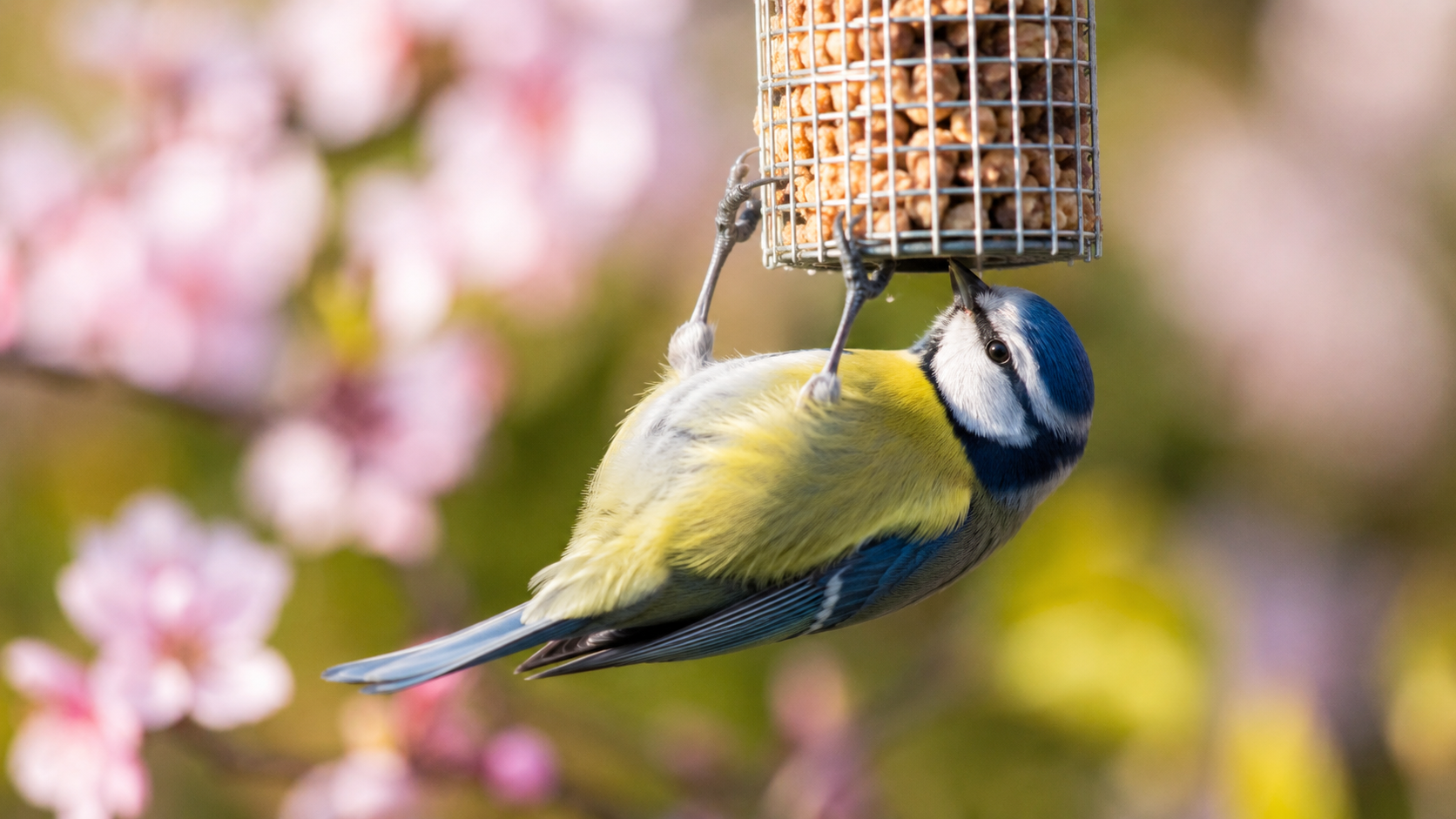
The Eurasian blue tit (Cyanistes caeruleus) is a small, compact tit with a wingspan of 17.5 to 20 cm and a body length of about 12 cm, weighing only around 9 to 12 grams — noticeably smaller and lighter than the closely related great tit. Its head shows a vivid blue cap bordered by a white face and a thin black eye-stripe, while the wings and tail are a rich blue and the underparts a clean bright yellow, giving the species one of the most colorful and easily recognized plumages among common European garden birds.
Sexes look broadly similar to the human eye, though males show slightly brighter, more UV-reflective blue crown feathers that are more distinguishable to other blue tits, which — unlike humans — can perceive ultraviolet light directly. Juveniles are duller and more yellow-green overall before their first full molt.
Range and habitat
The Eurasian blue tit is widespread across almost the whole of Europe and extends into western Russia and parts of the Caucasus and Middle East. It is strongly resident, with pairs generally remaining within a fairly small home range year-round, showing little tendency toward long-distance movement even in harsh winters.
It favors deciduous and mixed woodland, particularly oak-dominated forest, but has adapted extremely well to parks and gardens, where it is one of the most frequent and acrobatic visitors to bird feeders across its entire range, often outnumbering other small songbirds at well-stocked feeding stations.
Behavior and lifestyle
Diet follows a strongly seasonal pattern: caterpillars and other insects dominate during spring, when blue tits time egg-laying with remarkable precision to coincide with the short seasonal peak in caterpillar abundance needed to feed a large brood, while seeds, nuts, and garden feeder food become increasingly important through autumn and winter. This tight coupling between breeding timing and a brief natural food pulse has made the species one of the most closely studied models for understanding how climate-driven shifts in spring timing affect wild bird populations.
Blue tits are exceptionally acrobatic foragers, routinely hanging upside down from thin twigs and feeder perches to access food unavailable to larger, less agile birds, and their light weight and small size let them exploit feeding positions that species like the great tit cannot use as easily. Outside the breeding season, blue tits frequently join mixed foraging flocks with other tits and small songbirds moving together through woodland and gardens.
Breeding
Blue tits nest in tree cavities or readily in artificial nest boxes, competing directly with the somewhat larger great tit for the best available sites. The typical clutch is very large for a small songbird, ranging from 7 to 13 eggs, incubated solely by the female for 13 to 15 days. Chicks fledge at around 16 to 22 days old, and successfully raising such a large brood depends heavily on parents timing hatching to match the local caterpillar peak as closely as possible.
Interesting facts
- Long-term nest box monitoring programs studying blue tits across Europe have provided some of the clearest documented evidence of climate change advancing the timing of spring events in wild bird populations, with breeding now occurring measurably earlier in many populations than several decades ago.
- Blue tits were famously documented in 20th-century Britain learning to peck through the foil caps of milk bottles delivered to doorsteps to reach the cream beneath, a behavior that spread rapidly between populations and became a classic example of social learning in wild birds.
- Despite weighing barely 10 grams, blue tits are capable of surviving harsh winter nights by entering a controlled state of reduced body temperature called regulated hypothermia, conserving energy when food is scarce and temperatures are low.