Fieldfare
The fieldfare (Turdus pilaris) is a large, gregarious thrush known for forming big winter flocks in berry-laden trees and for its unusual, colonial breeding habit backed by coordinated group defense.
Key facts
- Latin name
- Turdus pilaris
- Family
- Turdidae (Thrushes)
- Wingspan
- 39–42 cm
- Season
- resident in parts of the range; largely migratory further north and east, present April – October, with large wintering flocks further south and west
- Diet
- Berries, especially rowan, hawthorn, and holly in autumn and winter, Earthworms and insects, especially in spring and summer, Windfall fruit in orchards, Snails and other invertebrates
- Conservation status
- LCLeast Concern
Appearance
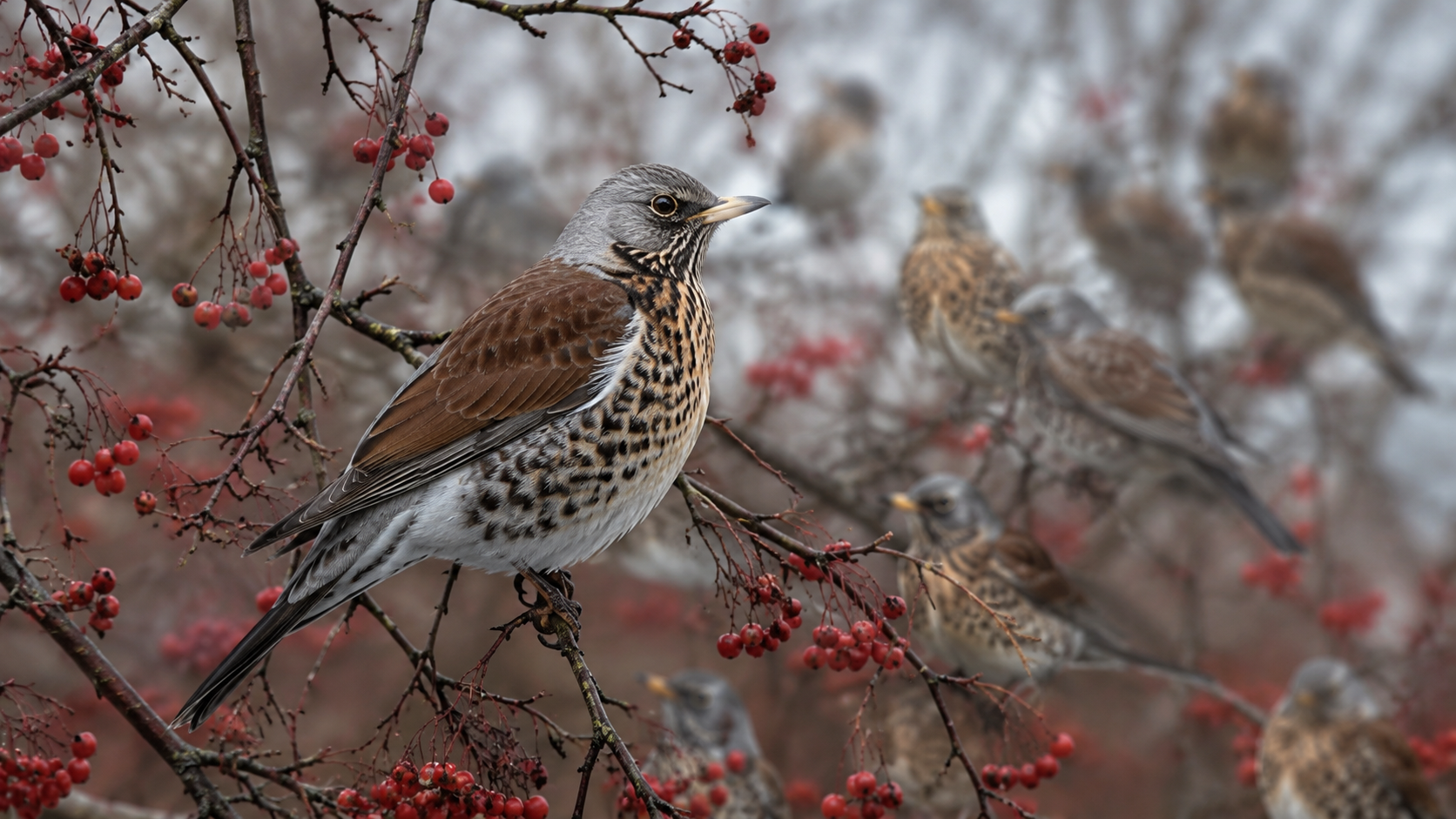
The fieldfare (Turdus pilaris) is the largest of the three thrushes covered in this atlas, with a wingspan of 39 to 42 cm and a body length of about 25 cm, weighing between roughly 80 and 140 grams. Its plumage is more strikingly patterned than either the blackbird or song thrush: a contrasting blue-grey head and rump set against a warm chestnut-brown back, with a heavily streaked and spotted buff-yellow breast and flanks, and a solid black tail visible clearly both at rest and in flight.
In flight, the fieldfare's combination of grey rump, black tail, and relatively large size, along with its habit of traveling and feeding in conspicuous flocks, usually makes it easy to distinguish from the other European thrushes even at a distance, well before individual plumage details can be seen clearly.
Range and habitat
The fieldfare breeds across a broad band of northern and eastern Europe and Russia, extending from Scandinavia through the boreal forest and forest-steppe zones into Siberia, with a smaller resident population in parts of central Europe. Most populations are migratory, present on the breeding grounds from roughly April to October and moving south and west in large numbers for the winter, when substantial flocks are a familiar sight across farmland and hedgerows well outside the breeding range.
It favors open woodland, forest edges, and — particularly outside the breeding season — farmland, orchards, and hedgerows rich in berry-bearing trees and shrubs, gathering wherever a reliable concentration of fruit is available through autumn and winter.
Behavior and lifestyle
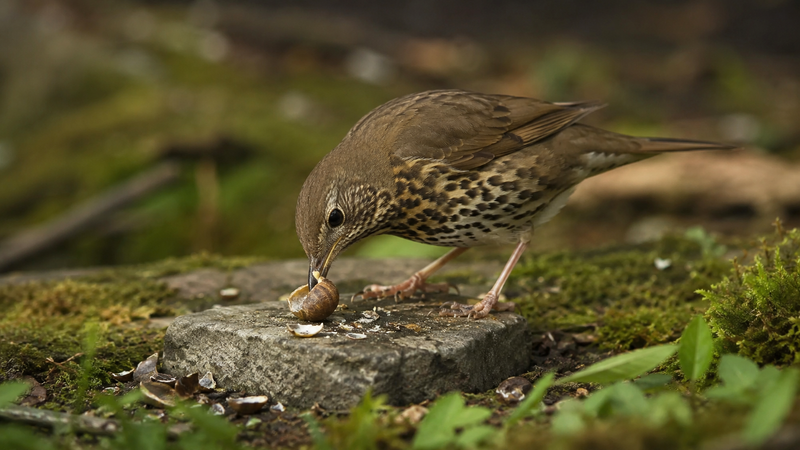
Fieldfares are highly gregarious for much of the year, feeding on berries, especially rowan, hawthorn, and holly, in large, often very conspicuous flocks that move together between rich feeding sites through autumn and winter, sometimes stripping a single berry-laden tree bare within a short time before moving on. During spring and summer, diet shifts more toward earthworms, insects, and other invertebrates, foraging on open ground much like other thrushes.
Unusually among European thrushes, fieldfares often breed semi-colonially, with multiple pairs nesting in reasonably close proximity within the same patch of woodland — a habit linked to a distinctive, effective form of collective nest defense in which neighboring pairs join together to mob an approaching predator, sometimes defecating on it as part of a coordinated group response that can genuinely drive off crows and other potential nest predators.
Breeding
The female builds a sturdy cup nest of grass and twigs, lined with mud and finer material similar in construction to a blackbird's nest, typically placed in a tree within loose proximity to other breeding pairs where the semi-colonial nesting pattern occurs. The typical clutch is 5 to 6 eggs, incubated mainly by the female for 11 to 14 days. Chicks fledge at around 12 to 16 days old, benefiting throughout from the added protection the colonial nesting arrangement provides against predators.
Interesting facts
- Large fieldfare flocks descending on a berry-laden tree can strip it of fruit remarkably quickly, a behavior that has occasionally brought the species into conflict with orchard growers when flocks target cultivated fruit crops in late autumn.
- The species' semi-colonial breeding and coordinated group mobbing defense is unusual enough among thrushes that it has attracted specific scientific study as an example of cooperative anti-predator behavior in an otherwise not particularly social breeding bird family.
- Fieldfare numbers passing through or wintering in a given region can vary substantially from year to year, driven largely by the size of the local berry crop, making the species one of the more visibly food-dependent winter visitors across much of its wintering range.