Song Thrush
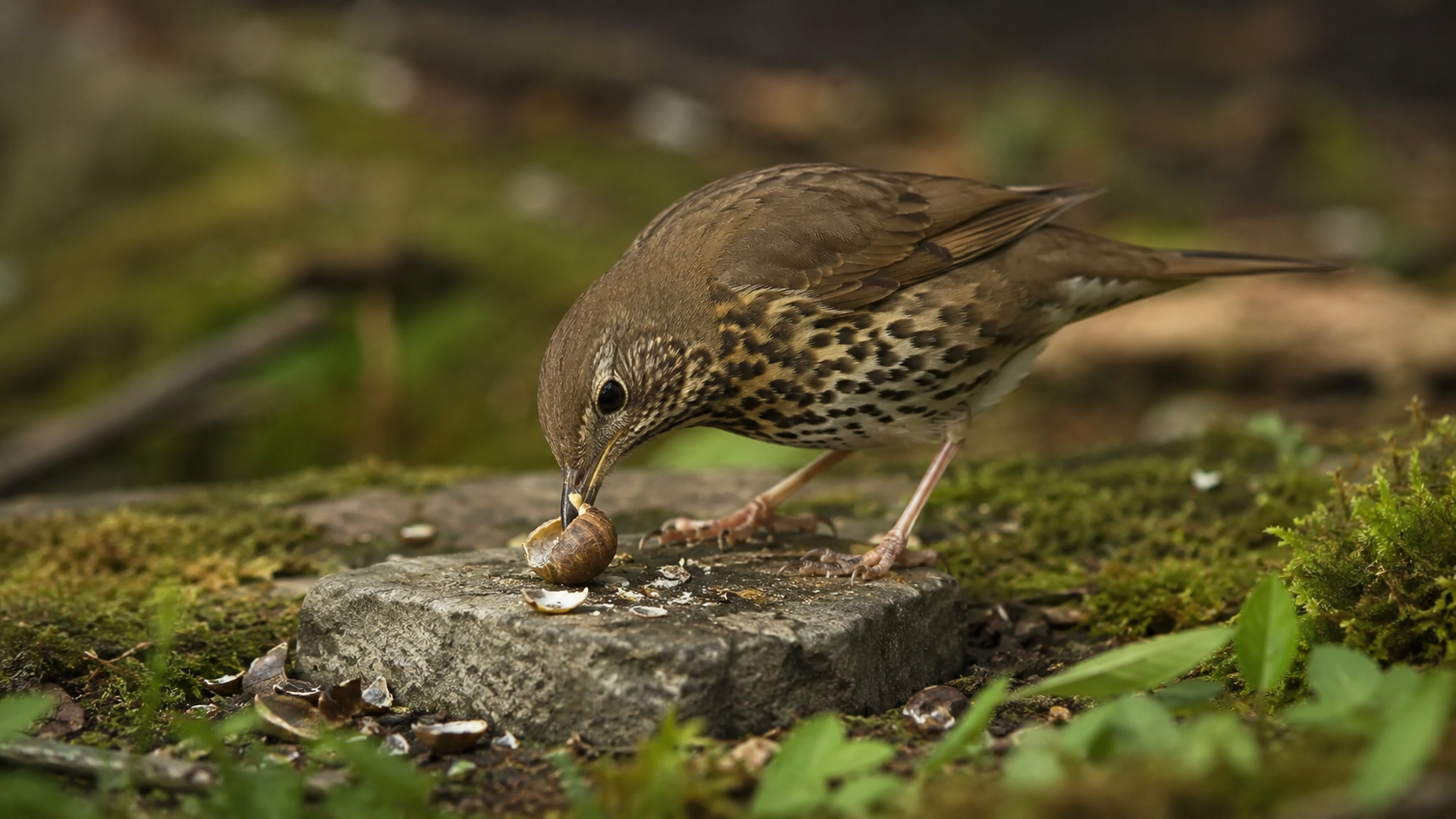
The song thrush (Turdus philomelos) is a richly spotted woodland thrush famous for its melodious, endlessly repeated song and its habit of smashing snail shells open on a favorite stone 'anvil.'
Key facts
- Latin name
- Turdus philomelos
- Family
- Turdidae (Thrushes)
- Wingspan
- 33–36 cm
- Season
- resident in the west and south; migratory further north and east, present April – October
- Diet
- Earthworms, especially after rain, Snails, opened by smashing the shell on a stone, Insects and other invertebrates, Berries and soft fruit, especially in autumn and winter
- Conservation status
- LCLeast Concern
Appearance
The song thrush (Turdus philomelos) is a medium-sized thrush with a wingspan of 33 to 36 cm and a body length of about 20 to 23.5 cm, weighing between roughly 50 and 107 grams. Its upperparts are a warm, uniform brown, while the underparts are pale cream to buff, densely marked with bold, dark, arrow- or triangle-shaped spots that extend from the throat down across the breast and flanks — a pattern distinct enough from the two other spotted European thrushes to allow confident identification with a little practice.
Compared to the larger mistle thrush, the song thrush is noticeably smaller and more compact, with warmer brown tones overall and a less densely, more evenly spaced pattern of spotting. A subtle but useful additional clue is the buff-orange wash visible under the wing in flight, best seen when the bird takes off suddenly from cover.
Range and habitat
The song thrush breeds across almost all of Europe and extends through temperate Russia into western Siberia. Populations in the milder west and south of the range are largely resident, while birds breeding in colder parts of central and northern Russia are migratory, present from roughly April to October and wintering further south and west, including around the Mediterranean.
It favors deciduous and mixed woodland with a well-developed shrub layer, along with parks, large gardens, and hedgerow-rich farmland, generally preferring somewhat denser cover than the closely related blackbird, though the two species frequently share the same broader habitat and can be seen foraging together on open lawns.
Behavior and lifestyle
Song thrushes forage mainly on the ground, taking earthworms, particularly abundant and accessible after rain, alongside snails, insects, and other invertebrates, shifting toward berries and soft fruit as these become available in late summer and autumn. Its distinctive snail-smashing behavior, using a favored stone "anvil" to break open shells the bird cannot otherwise access, is one of the best-documented examples of tool-assisted foraging in a common European songbird.
The male's song is loud, rich, and highly variable, built from a large repertoire of musical phrases, each of which is typically repeated two or three times in succession before the bird moves on to a new phrase — a structural habit that makes song thrush song relatively easy to recognize even by ear alone, and one that has attracted particular attention from poets and naturalists alike.
Breeding
The female builds a neat, deep cup nest lined uniquely among common European thrushes with a smooth coating of mud or rotten wood pulp rather than soft plant material, typically placed in dense shrub or low tree cover. The typical clutch is 3 to 5 eggs, incubated solely by the female for 11 to 15 days. Chicks fledge at around 12 to 16 days old, and pairs commonly raise two or three broods across an extended breeding season from spring into summer.
Interesting facts
- Song thrush populations in parts of Western Europe declined substantially during the late 20th century, an issue linked partly to agricultural intensification reducing earthworm and snail availability on farmland, prompting targeted conservation research and monitoring in several countries.
- The bird's habit of returning repeatedly to the same stone anvil to smash snail shells can leave a visible, long-term accumulation of broken shell fragments at a favored site, sometimes used by naturalists to confirm a song thrush's presence in an area even without seeing the bird directly.
- The song thrush's habit of repeating each song phrase multiple times was famously referenced in Robert Browning's 1845 poem "Home-Thoughts, from Abroad," which describes the thrush singing "each song twice over" to prove it can recapture "that first fine careless rapture."