European Turtle Dove
The European turtle dove (Streptopelia turtur) is a small, warm-toned migrant dove known for its soft purring song and a population decline so steep it is now classified as globally Vulnerable.
Key facts
- Latin name
- Streptopelia turtur
- Wingspan
- 47–53 cm
- Season
- April – September, wintering in the Sahel region of sub-Saharan Africa
- Diet
- Seeds of wild plants, especially fumitory and other arable weeds, Cereal grain, gleaned from stubble and field margins, Small legume seeds and other farmland plant seeds
- Conservation status
- VUVulnerable
Appearance
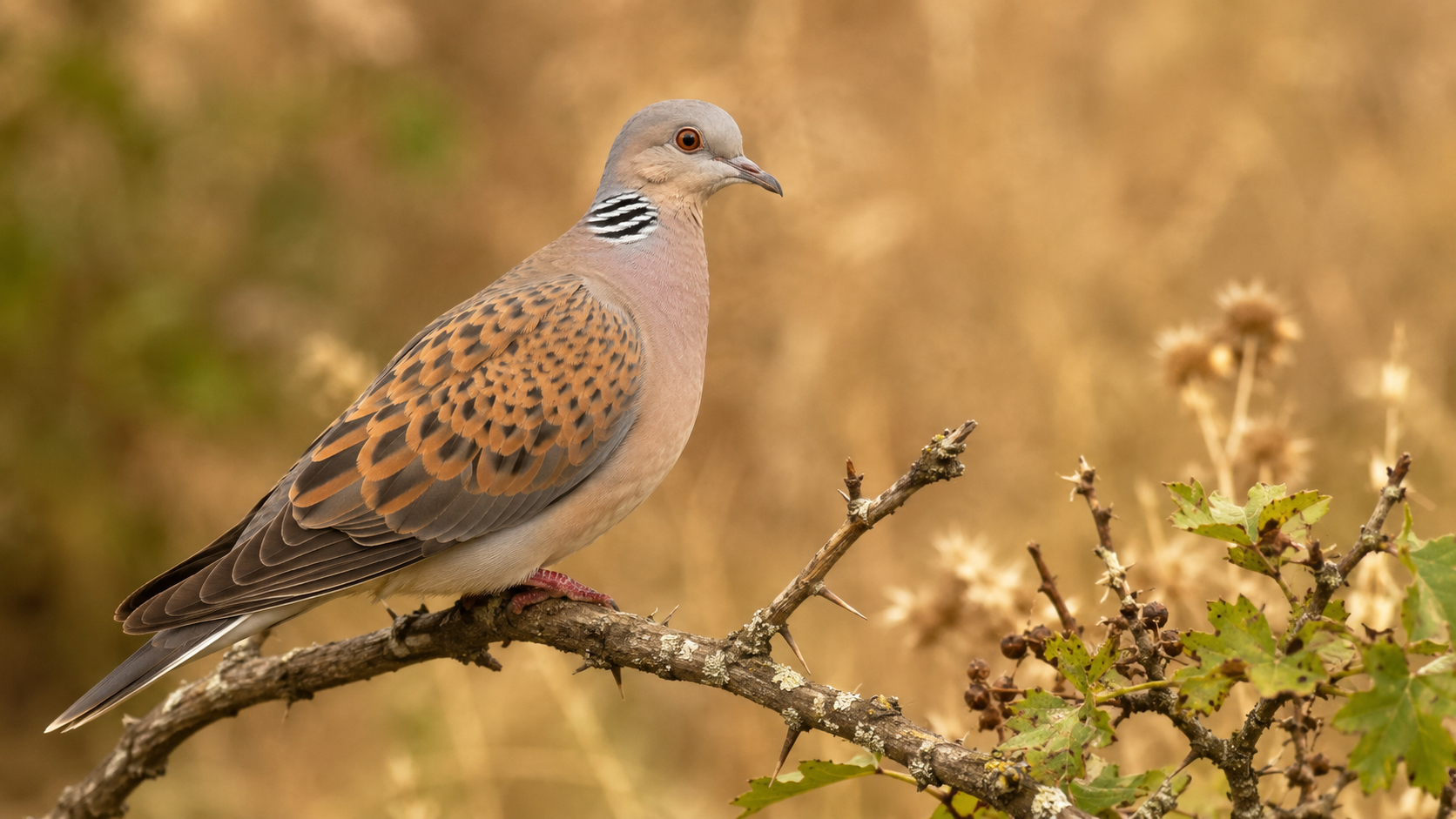
The European turtle dove (Streptopelia turtur) is a small, slender dove with a wingspan of 47–53 cm and a body length of 26–28 cm, weighing between roughly 130 and 180 grams, noticeably smaller and more delicately built than either the rock dove or wood pigeon covered elsewhere in this atlas. Its most distinctive feature is a warm, rufous-orange and black scaled pattern across the wing coverts, giving the folded wing a scalloped, tortoiseshell-like appearance found in no other common local dove.
The head and underparts are a soft pinkish-grey, and the neck shows a small patch of black-and-white striped feathers on each side, a subtler marking than the bold collar of the related collared dove. In flight, the turtle dove appears notably fast and agile for its size, with quick, direct wingbeats quite different from the heavier, more labored flight typical of the larger wood pigeon.
Range and habitat
The European turtle dove breeds across much of temperate Europe, North Africa, and western Asia, including parts of southern and central Russia, favoring warm, open farmland with scattered hedgerows, scrub, and small woodland patches that provide both nesting cover and access to open ground for feeding. Historically one of the most familiar sounds of European summer farmland, the species has become considerably scarcer and more localized across much of its western range in recent decades.
The turtle dove is entirely migratory, present on breeding grounds from April to September and undertaking a long-distance migration to winter in the Sahel region of sub-Saharan Africa, a journey that exposes the species to a range of pressures across multiple countries and has made international, flyway-wide conservation coordination central to efforts to reverse its decline.
Behavior and lifestyle
Turtle doves feed almost entirely on seeds, historically relying heavily on the seeds of wild arable weeds such as fumitory found on unsprayed or lightly farmed field margins, supplemented by cereal grain gleaned from stubble fields. This narrow dietary reliance on weed seeds has made the species particularly vulnerable to the intensification of modern farming, which has sharply reduced the availability of its preferred wild food plants across much of its western range.
The species is generally shy and easily disturbed compared with other common doves, typically feeding on the ground in relatively open but sheltered areas close to hedgerow or scrub cover it can retreat to quickly. Its soft, rolling purring song, delivered steadily from a perch during the breeding season, was once one of the defining background sounds of European summer farmland, though it has become noticeably less common as the species has declined.
Breeding
Turtle doves build a simple, flimsy platform nest of twigs, typically placed in a dense hedgerow, scrub thicket, or small tree offering good concealment. A typical clutch contains 2 eggs, incubated by both parents for 13 to 14 days, one of the shorter incubation periods among the doves and pigeons covered in this atlas.
Pairs can raise two to three broods across the breeding season where conditions allow, with chicks fed initially on crop milk before transitioning to seeds, fledging at around 18 to 21 days. However, breeding success across much of the western range has become increasingly constrained by reduced availability of both suitable nesting cover and adequate seed food nearby.
Interesting facts
- The turtle dove has long been a cultural symbol of devoted love and fidelity in Western literature and folklore, referenced from classical antiquity through Shakespeare and the well-known Christmas carol "The Twelve Days of Christmas."
- Population monitoring across parts of Western Europe has recorded declines exceeding 90 percent since the late 20th century, among the steepest documented declines of any widespread European farmland bird.
- Because of this steep decline, the European turtle dove is now classified as globally Vulnerable by the IUCN, and its recovery has become a flagship focus for several international farmland bird and migratory flyway conservation initiatives.