White Stork
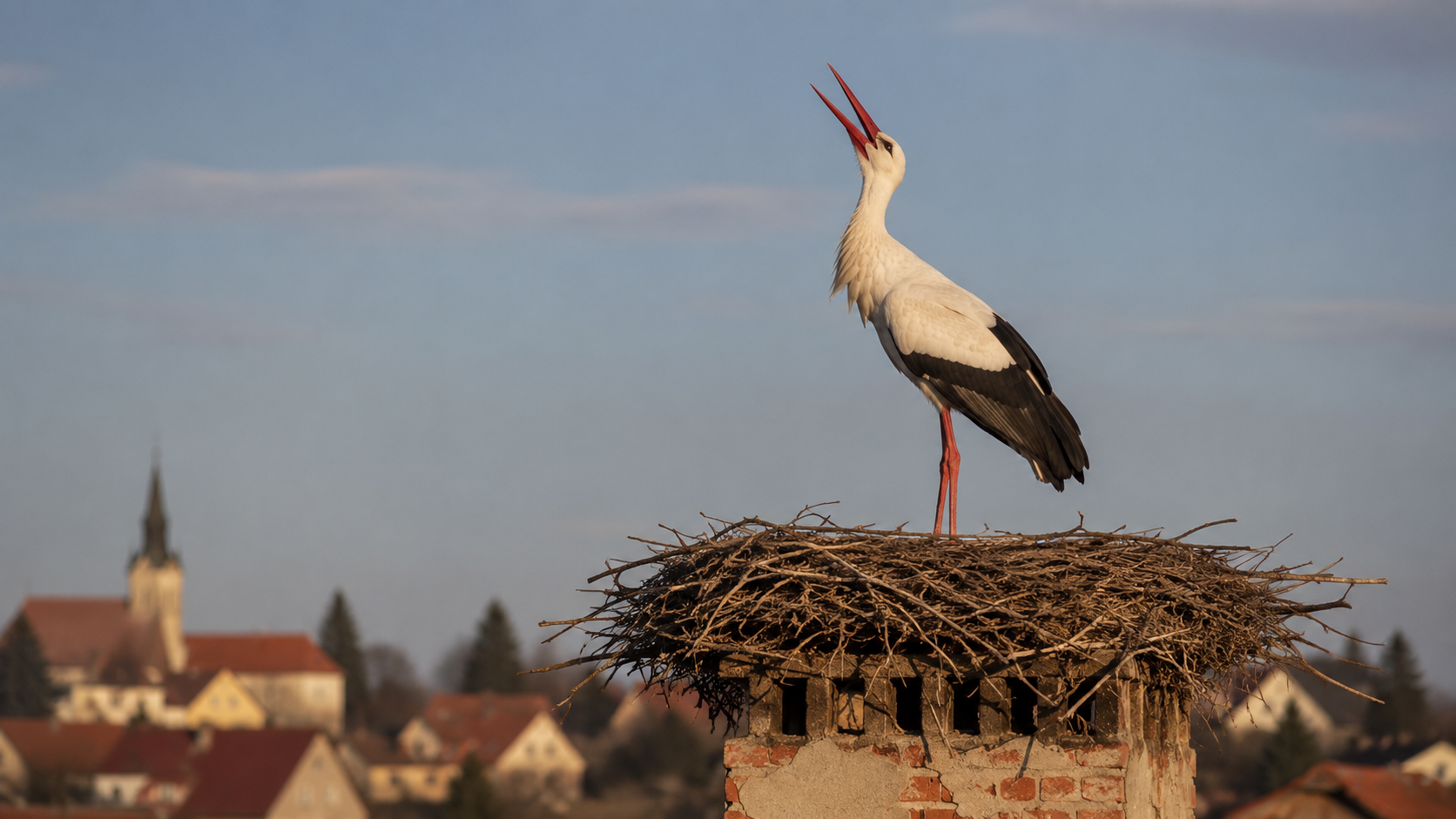
The white stork (Ciconia ciconia) is a massive, long-legged wetland and farmland bird famous for its huge stick nests on rooftops and chimneys, and for a bill-clattering display that replaces true vocal calls.
Key facts
- Latin name
- Ciconia ciconia
- Family
- Ciconiidae (Storks)
- Wingspan
- 155–215 cm
- Season
- April – September, wintering in sub-Saharan Africa
- Diet
- Frogs, toads, and other amphibians, Large insects, especially grasshoppers and beetles, Small mammals, including voles and mice, Fish and occasional small reptiles
- Conservation status
- LCLeast Concern
Appearance
The white stork (Ciconia ciconia) is one of the largest birds covered in this atlas, with a wingspan of 155–215 cm and a body length of 100–125 cm, weighing between roughly 2.3 and 4.5 kilograms. Its plumage is almost entirely pure white, broken only by glossy black flight feathers along the trailing edge and tips of the wings, clearly visible both at rest, when the folded wingtips extend beyond the tail, and especially in flight, when the contrast between white body and black wing edges becomes striking.
Its bill and legs are both a bright, unmistakable red, long and straight in the case of the bill, an adaptation well suited to probing and seizing prey in shallow water and open ground alike. In flight, the white stork holds its long neck fully extended forward, distinguishing it at a distance from herons, which typically fly with the neck folded back into an S-shape.
Range and habitat
The white stork breeds across much of Europe, including substantial populations through Russia, Ukraine, and the Baltic states, favoring open lowland habitats with a mix of wet feeding grounds — marshes, wet meadows, and shallow water — and elevated nesting sites nearby, whether tall trees, utility poles, or, especially in villages and small towns, rooftops and chimneys. This close association with traditional agricultural and village landscapes has made it one of Europe's most culturally recognized birds.
European breeding populations are entirely migratory, present on breeding grounds from April to September and undertaking one of the longest and most dramatic migrations of any large European bird to winter across sub-Saharan Africa, traveling via one of two established overland flyways around the Mediterranean that avoid extended sea crossings unsuited to the species' soaring flight style.
Behavior and lifestyle
White storks hunt mainly by walking slowly and deliberately across open ground and shallow water, watching for movement before seizing prey with a quick strike of the bill. Their diet is broadly varied and highly opportunistic, dominated by frogs and other amphibians in wetland habitat, supplemented by large insects such as grasshoppers and beetles, small mammals including voles and mice taken on farmland, and fish in shallower water.
Migration relies heavily on soaring flight, using rising columns of warm air, or thermals, over land to gain altitude with minimal energy expenditure before gliding onward, a technique that concentrates migrating storks along specific overland routes and produces some of the most visible mass migration spectacles of any large bird in Europe, with hundreds or even thousands of storks sometimes visible together at key crossing points.
Breeding
White storks build enormous stick nests, often reused and enlarged over many years until they can weigh several hundred kilograms, typically sited on a stable elevated structure such as a rooftop, chimney, utility pole, or tall tree. A typical clutch contains 3 to 5 eggs, incubated by both parents for 31 to 34 days, with pairs often reusing the same nest site across multiple breeding seasons.
Chicks are fed by both parents through regurgitation and remain in the nest for an extended period, fledging at around 58 to 64 days, one of the longer nestling periods among the species covered in this atlas, reflecting the substantial size the young must reach before their first flight. Successful pairs often show strong nest-site fidelity, returning to the same nest year after year if it survives the winter intact.
Interesting facts
- White stork nests are sometimes maintained and expanded across multiple generations of storks, occasionally reaching well over a meter across and persisting on the same structure for decades.
- Because adult white storks rarely vocalize, bill-clattering has become the species' primary communication display, audible from a considerable distance and often performed as a greeting ritual when a returning mate arrives at the nest.
- White stork populations declined significantly across parts of Western Europe during the 20th century due to wetland drainage and pesticide use, but the species has recovered strongly in many areas through conservation programs and remains classified as Least Concern.