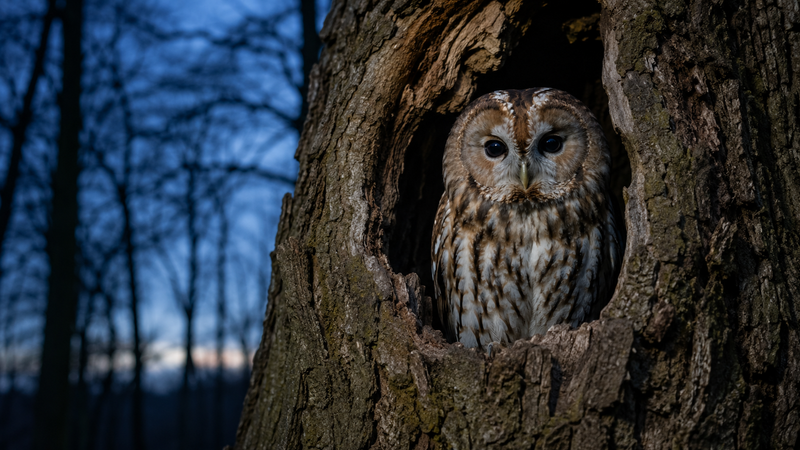
Eurasian Eagle-Owl
The Eurasian eagle-owl (Bubo bubo) is one of the largest owls in the world, a powerful nocturnal predator of cliffs and forests capable of taking prey as large as foxes and other raptors.

Key facts
- Latin name
- Bubo bubo
- Family
- Strigidae (Typical Owls)
- Wingspan
- 160–188 cm
- Season
- resident year-round
- Diet
- Small to medium mammals (hares, rats, hedgehogs), Other birds of prey and owls, Waterbirds and large game birds, Occasionally young foxes or roe deer fawns
- Conservation status
- LCLeast Concern
Appearance
The Eurasian eagle-owl (Bubo bubo) is a massive owl with a wingspan of 160 to 188 cm, a body length of 58 to 75 cm, and a weight ranging from about 1.6 kilograms in small males up to 4.2 kilograms in the largest females — figures that place it among the largest owl species anywhere in the world. Long, prominent, widely spaced ear tufts and deep, glowing orange eyes give it an unmistakable, almost feline expression, further emphasized by a barrel-shaped body and powerful, heavily feathered legs.
Plumage is richly patterned in tawny, buff, and dark brown tones, densely streaked and mottled across the back and underparts in a pattern that provides remarkably effective camouflage against rock and bark despite the bird's enormous size. In flight, its broad wings and sheer bulk can create a silhouette sometimes mistaken for a large bird of prey rather than an owl, particularly at dusk when the ear tufts are less obvious.
Range and habitat
The Eurasian eagle-owl has an extensive range across most of continental Europe and Asia, from Iberia and Scandinavia through Russia to the Pacific coast, generally absent only from the British Isles, where it does not naturally occur, and the high Arctic. It is strongly resident, with pairs defending large, stable territories year-round rather than migrating.
It favors rugged, varied terrain — rocky cliffs, gorges, quarries, and forest edges near open hunting ground — nesting typically on cliff ledges, in quarry faces, or occasionally on the ground at the base of a tree or rock, and increasingly in the disused nests of other large birds. Large territories and a need for undisturbed nesting sites mean the species tends to be scarce even where suitable rugged terrain exists.
Behavior and lifestyle
As one of the most powerful nocturnal predators in its range, the eagle-owl takes an unusually broad spectrum of prey by owl standards, from small rodents up to hares, hedgehogs, waterbirds, large game birds, and — notably — other birds of prey and owls, including species as large as buzzards, taken while roosting at night when they are far more vulnerable than during daylight hours. Young foxes and roe deer fawns are occasionally recorded as prey as well, reflecting the sheer physical power available to a bird of this size.
Hunting is carried out almost entirely from perches within its territory, using acute night vision and hearing to detect prey before a short, powerful flight to seize it. Its deep, resonant "oo-hu" call, audible over long distances on calm nights, is one of the most far-carrying territorial sounds of any bird in its range and is most frequently heard during the winter and early spring lead-up to breeding.
Breeding
Eagle-owls build no true nest, instead laying eggs in a shallow scrape on a cliff ledge, in a quarry face, on the ground beneath cover, or occasionally in an old stick nest built by another large bird. The typical clutch is 2 to 4 eggs, incubated solely by the female for around 31 to 36 days while the male provides food. Chicks fledge at roughly 50 to 60 days old but remain dependent on their parents for several months, sometimes staying within the natal territory well into their first winter before dispersing to find territory of their own.
Interesting facts
- The Eurasian eagle-owl has few natural predators as an adult, making collisions with power lines and, increasingly, wind turbines among the leading causes of death for the species in much of its range today.
- Long-running reintroduction and conservation programs across parts of Western Europe have helped eagle-owl populations recover in areas where the species had been eliminated by persecution, though recovery remains uneven across its full range.
- Despite its formidable size and hunting power, the eagle-owl relies heavily on camouflage and stillness during the day, roosting motionless against rock or tree cover where its mottled plumage renders even a bird this large surprisingly easy to overlook.