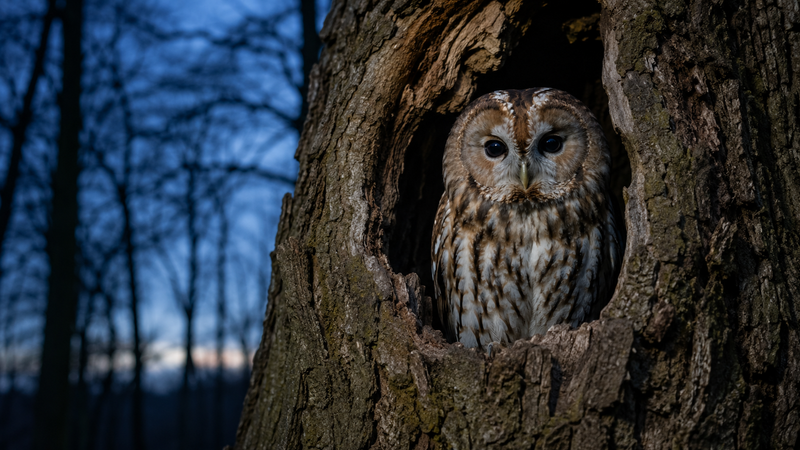
Long-eared Owl
The long-eared owl (Asio otus) is a slender, secretive owl of dense conifers, instantly recognizable by its long feathered ear tufts and fiery orange eyes, and famous for forming communal winter roosts.

Key facts
- Latin name
- Asio otus
- Family
- Strigidae (Typical Owls)
- Wingspan
- 86–98 cm
- Season
- resident in the west and south; partially migratory further north and east, present year-round with movements October – March
- Diet
- Voles, especially the common vole and field vole, Mice and other small rodents, Small birds, taken occasionally, Large insects, rarely
- Conservation status
- LCLeast Concern
Appearance
The long-eared owl (Asio otus) is a slender, medium-sized owl with a wingspan of 86 to 98 cm and a body length of 31 to 37 cm, weighing between roughly 220 and 435 grams. Its most striking feature is a pair of long, upright feathered ear tufts, positioned close together toward the center of the head, which the bird raises when alert or lowers flat when trying to blend into cover — the tufts are purely for camouflage and signaling and play no role in hearing.
Plumage is intricately mottled in warm buff, rufous, and grey-brown tones with fine vertical streaking, providing exceptional camouflage against tree bark when the owl adopts its characteristic elongated, thin-bodied concealment posture pressed close to a trunk. Its eyes are a vivid, striking orange, brighter and warmer than the tawny owl's dark eyes, and set within a distinct rusty-orange facial disc rimmed in black and white.
Range and habitat
The long-eared owl breeds across a broad band of temperate Eurasia and North America, present throughout most of Europe and Russia from the western border deep into Siberia. Populations in the milder west and south of the range are largely resident, while birds breeding in colder parts of central and northern Russia move south for the winter, so many areas see both resident pairs and an influx of wintering birds from further north between October and March.
It favors dense stands of conifers or thick hedgerows, particularly at the edge of open farmland, grassland, or steppe where it can hunt small mammals over open ground while retreating into cover to roost during the day. This combination of dense daytime cover next to open hunting ground makes shelterbelts and forest edges especially attractive habitat.
Behavior and lifestyle
Unlike the more powerfully built tawny owl, the long-eared owl relies heavily on voles, particularly the common vole and field vole, as its primary prey, hunting almost entirely at night in low, quartering flight low over open fields and grassland, or from a series of low perches at the edge of cover. Its diet narrows sharply toward rodents compared to more generalist owls, making local populations sensitive to fluctuations in vole numbers between years.
One of the species' most distinctive behaviors is forming communal winter roosts, sometimes numbering a dozen or more birds tightly clustered together in a single dense conifer, a striking departure from the strictly solitary roosting habits of most owls. These roosts can persist at the same site across multiple winters and have made the species relatively easy to survey where known roost sites are monitored.
Breeding
Long-eared owls do not build their own nest, instead taking over an old crow's, magpie's, or squirrel's nest, usually in a dense conifer. The typical clutch is 3 to 8 eggs, most commonly 4 or 5, with clutch size varying noticeably with local vole abundance; incubation, carried out by the female, lasts around 25 to 30 days. Chicks leave the nest at about 23 to 24 days old, before they can fly, clambering onto nearby branches in a "branching" stage similar to young tawny owls, and reach full flight roughly two weeks later.
Interesting facts
- When threatened at the nest, a long-eared owl will sometimes perform a dramatic broken-wing distraction display, feigning injury on the ground to lure a predator away from its chicks before flying off once the danger has been drawn far enough away.
- Communal winter roosts of long-eared owls have occasionally been recorded with several dozen individuals at a single site, making them one of the few reliable places to see multiple owls of the same species together at once.
- Because its diet depends so heavily on voles, the long-eared owl's breeding success and even local population size can swing noticeably between years depending on the natural boom-and-bust cycles of vole populations.