Eurasian Golden Oriole
The Eurasian golden oriole (Oriolus oriolus) is one of the most brilliantly colored songbirds in Europe, yet its shy, canopy-dwelling habits mean it is far more often heard than seen.
Key facts
- Latin name
- Oriolus oriolus
- Wingspan
- 44–47 cm
- Season
- May – August, wintering in sub-Saharan Africa
- Diet
- Caterpillars and other large insects, especially during the breeding season, Fruit and berries, especially in late summer before migration
- Conservation status
- LCLeast Concern
Appearance
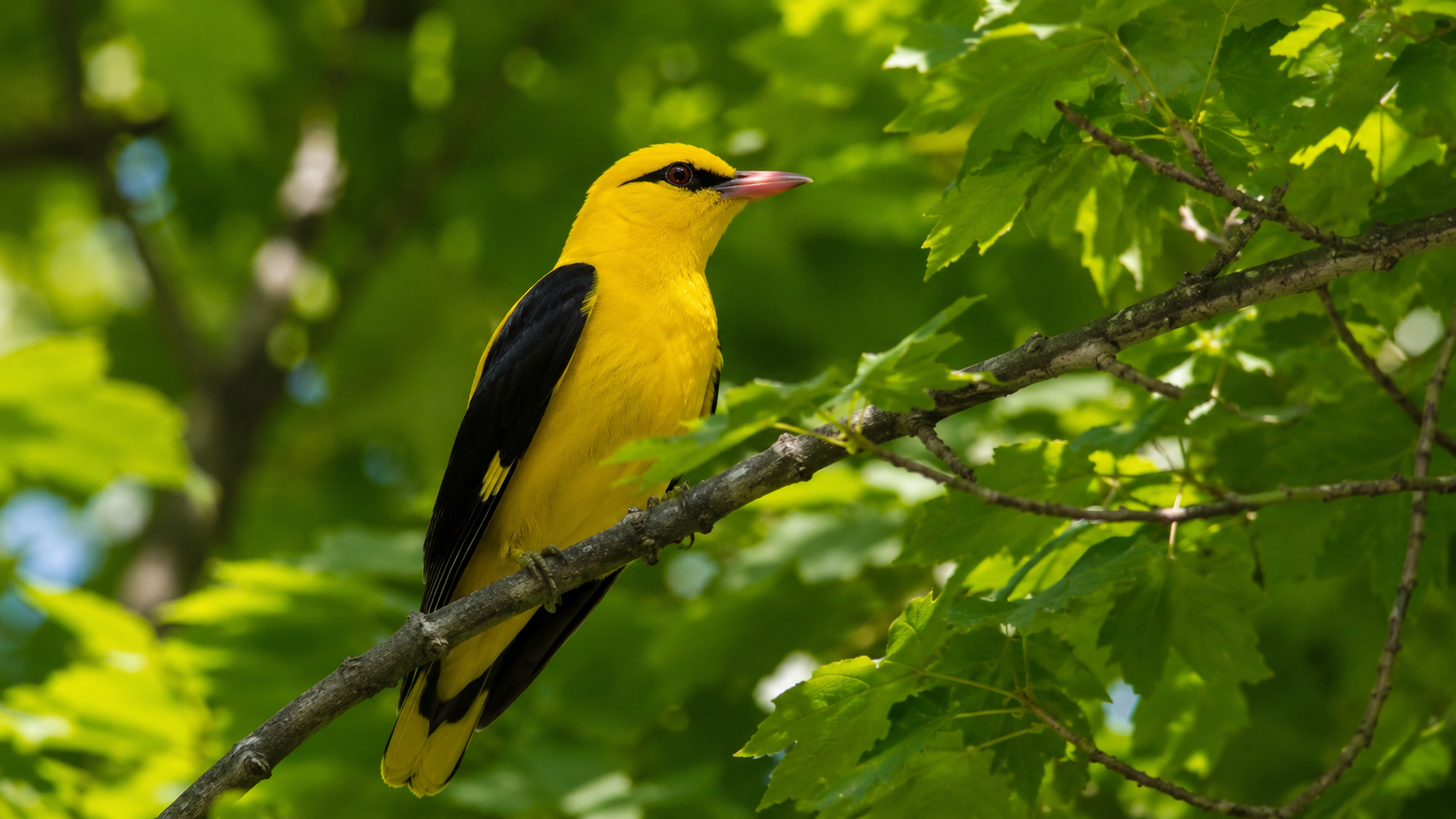
The Eurasian golden oriole (Oriolus oriolus) is a medium-sized songbird with a wingspan of 44 to 47 cm and a body length of about 22 to 25 cm, weighing between roughly 50 and 90 grams. The adult male is one of the most brilliantly colored songbirds found in Europe, with a vivid, saturated golden-yellow body sharply set off by bold, contrasting black wings and tail, and a small black stripe running from the beak through the eye.
Females and juveniles are considerably duller, showing a more muted, greenish-yellow overall tone with some streaking on the underparts rather than the male's clean, bold color blocks, a difference substantial enough that the two sexes can appear almost like different species to an observer unfamiliar with the pattern. Despite the male's dramatic coloring, both sexes are notoriously difficult to see clearly in the field due to the species' consistently shy, canopy-dwelling habits.
Range and habitat
The Eurasian golden oriole breeds across much of Europe and extends into western and central Russia and parts of Central Asia. It is entirely migratory, present on the breeding grounds only briefly, from roughly May to August, before undertaking a long journey to winter across sub-Saharan Africa.
It favors mature deciduous woodland with a tall, well-developed canopy, particularly poplar and other broadleaf stands near rivers and wetlands, along with large orchards and parkland offering similarly tall tree cover, and is generally absent from coniferous forest and more open, treeless habitats.
Behavior and lifestyle
Golden orioles feed mainly on caterpillars and other large insects during the breeding season, gleaned from foliage high in the canopy, shifting toward fruit and berries as these become available later in summer, building fat reserves ahead of the return migration to Africa. Foraging takes place almost entirely within dense leafy canopy, rarely bringing the bird down to more open, visible perches.
The species' shy, elusive habits mean that its rich, fluting, far-carrying song is usually a far more reliable indicator of its presence than any direct sighting, and experienced birdwatchers in oriole habitat typically rely on this distinctive call to confirm the species is present in an area long before, if ever, catching a clear view of the bird itself moving through dense summer foliage.
Breeding
The female builds a distinctive hammock-like cup nest, suspended between a forked branch high in the canopy and woven so that it hangs securely from the supporting fork rather than resting directly on top of a branch, an unusual construction style among European songbirds. The typical clutch is 3 to 4 eggs, incubated mainly by the female for 14 to 15 days. Chicks fledge at around 15 to 17 days old, and pairs typically raise a single brood given the relatively short breeding window available on the northern breeding grounds.
Interesting facts
- Despite its brilliant plumage, the golden oriole's combination of a bright yellow body and dark wings actually provides effective camouflage against sun-dappled leaves when viewed from below, illustrating that bold coloration and effective camouflage are not always mutually exclusive.
- The species' distinctive hanging nest construction has drawn comparisons to weaver bird nests found elsewhere in the world, though the two groups are not closely related and arrived at broadly similar suspended-nest solutions independently.
- Golden oriole numbers and range in parts of northern Europe have shown some expansion in recent decades, a pattern some researchers link to a warming climate making previously marginal areas increasingly suitable breeding habitat for the species.