Black-necked Grebe
The black-necked grebe (Podiceps nigricollis) is a small colonial-nesting grebe known for its striking golden ear-tufts, red eyes, and preference for breeding on shallow, gull-fringed lakes.
Key facts
- Latin name
- Podiceps nigricollis
- Family
- Podicipedidae (Grebes)
- Wingspan
- 56–60 cm
- Season
- April – September on breeding lakes, with birds wintering on ice-free coastal and inland waters further south
- Diet
- Aquatic insects and their larvae, Small crustaceans, Tiny fish and fry, Freshwater molluscs
- Conservation status
- LCLeast Concern
Appearance
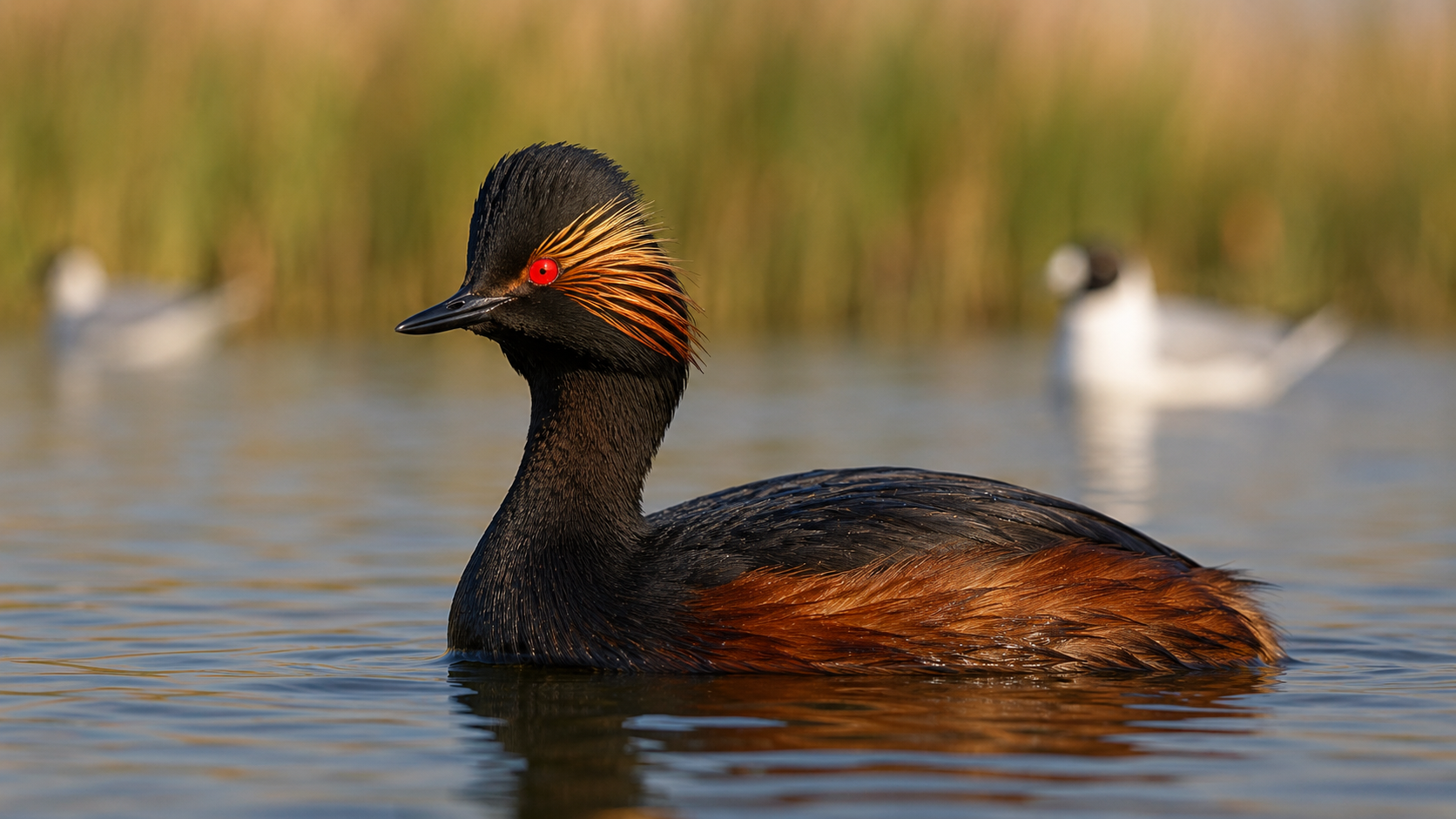
The black-necked grebe is a compact, short-necked diving bird with a distinctive peaked crown that gives the head a steep, high-forehead profile unlike any other European grebe. In breeding plumage the head and neck are glossy black, set off by a spray of thin golden-yellow feathers — the ear-tufts — that fan out behind the piercing red eye and can be raised or flattened depending on the bird's mood. The flanks glow chestnut-red against a blackish back, while the belly stays clean white. Outside the breeding season the plumage turns a much plainer sooty-grey above and white below, and the golden tufts disappear entirely, leaving the peaked crown and thin, faintly upturned black bill as the most reliable field marks.
Range and habitat
Black-necked grebes breed across a broad band of temperate Eurasia and parts of North America and Africa, favoring shallow, eutrophic lakes and ponds with abundant emergent vegetation and, crucially, a nearby colony of black-headed gulls or terns. In much of central and eastern Europe they are patchy and often numerous only where such colonies exist, since suitable sites can shift from year to year as gull colonies relocate. After breeding, birds move to larger lakes, reservoirs, and sheltered coastal bays, sometimes gathering in large pre-migration flocks before continuing on to wintering areas around the Mediterranean, the Black and Caspian seas, and further south.
Behavior and lifestyle
Highly aquatic and reluctant to fly except during migration, black-necked grebes spend almost all their time swimming and diving, disappearing beneath the surface with a quick forward roll to hunt insects and small crustaceans among submerged plants. They are notably gregarious for grebes, often diving in loose, synchronized groups and gathering in dense post-breeding flocks that can number in the thousands on favored staging lakes. Like other grebes, they undergo a flightless period during their molt, timing it to coincide with these safe, food-rich staging waters.
Breeding
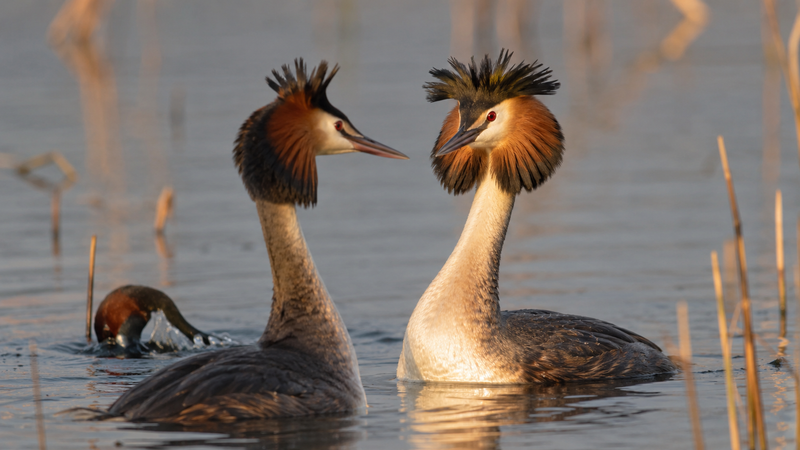
Pairs perform an elaborate courtship display involving synchronized head-shaking, penguin-like upright postures, and mutual presenting of waterweed, broadly similar to the great crested grebe's ritual but performed at closer range within the crowded colony. Nests are floating platforms of waterweed anchored to emergent vegetation, built within meters of neighboring pairs and often intermixed with nesting gulls. Both parents incubate the three to four eggs and, once hatched, the striped downy chicks quickly take to riding on a parent's back, a habit that keeps them warm and safe from both predators and rival grebes in the crowded colony.
Interesting facts
Before migrating, black-necked grebes undergo a remarkable internal transformation: their digestive organs enlarge and flight muscles atrophy while feeding intensively on the abundant brine shrimp of certain staging lakes, then the process reverses as they prepare to fly, a physiological flexibility shared by only a handful of bird species. Their association with gull colonies is so strong that ornithologists sometimes use the presence of a large black-headed gull colony as a predictor of where to find breeding black-necked grebes in a given year.