Great Crested Grebe
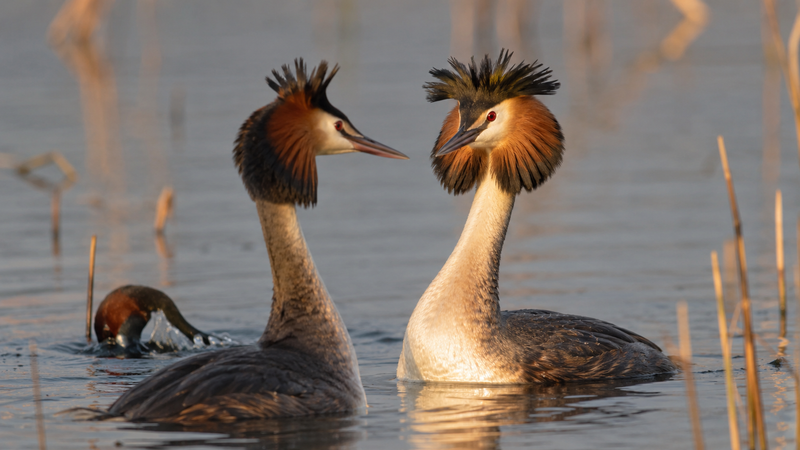
The great crested grebe (Podiceps cristatus) is the largest Eurasian grebe, famous for its elaborate mutual courtship dance and its ornate double crest and chestnut-and-black head ruff.
Key facts
- Latin name
- Podiceps cristatus
- Family
- Podicipedidae (Grebes)
- Wingspan
- 59–73 cm
- Season
- April – October in most of the range, with some populations wintering on unfrozen coastal or inland waters further south and west
- Diet
- Fish, caught during dives that can exceed a minute underwater, Aquatic insects and their larvae, Freshwater crustaceans, Amphibians
- Conservation status
- LCLeast Concern
Appearance
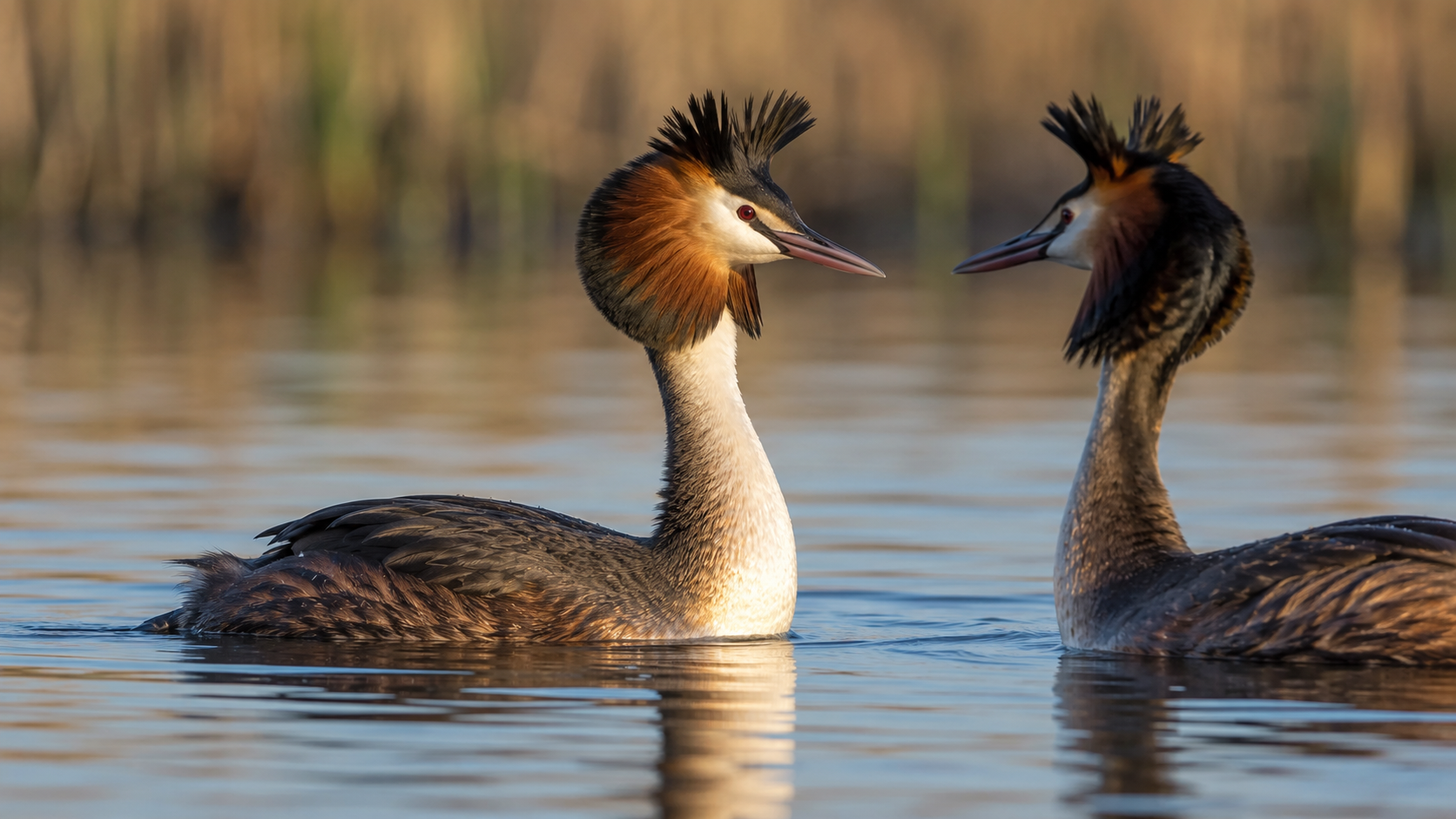
The great crested grebe (Podiceps cristatus) is the largest grebe found across most of Europe and Asia, with a wingspan of 59–73 cm and a body length of 46–51 cm. In breeding plumage it shows a slender white neck and face, a dark double crest atop the head, and a striking chestnut-and-black ruff framing the sides of the head and neck, ornaments that are largely lost outside the breeding season, leaving a plainer grey-brown and white bird.
Its body rides notably low in the water, and its long, straight, dagger-like pinkish bill and elongated neck give it a distinctly slender profile compared with the rounder shape of ducks and other waterbirds sharing the same lakes, a difference in posture that is often the quickest way to pick the species out at a distance even without clear plumage detail.
Range and habitat
The great crested grebe is widespread across much of Europe and Asia, including most of Russia south of the northern taiga and tundra, favoring larger lakes, reservoirs, and slow rivers with a mix of open water for diving and fringing reed beds or other emergent vegetation for nesting cover. It is considerably more tolerant of open water than the smaller little grebe, often visible well out from shore even during the breeding season.
Populations breeding across the colder, more continental parts of the range are migratory, present from roughly April to October and moving to milder coastal or inland waters further south and west for winter, while populations in milder parts of western and southern Europe are much more sedentary, remaining on suitable open water year-round.
Behavior and lifestyle
Great crested grebes are powerful, sustained divers, capable of remaining submerged for well over a minute while pursuing fish, their primary prey, along with aquatic insects, crustaceans, and amphibians taken opportunistically. Like other grebes, the species regularly ingests its own feathers, forming a matted stomach plug believed to protect the digestive tract from sharp fish bones.
The species is best known for its elaborate courtship behavior, including synchronized head-shaking displays and the dramatic 'weed dance', in which both members of a pair dive together to gather waterweed and then rise up the water surface breast-to-breast in near-vertical unison, a ritual that plays an important role in establishing and maintaining the pair bond ahead of nesting.
Breeding
Nests are floating platforms of waterweed anchored to reeds or other emergent vegetation, built to rise and fall safely with changing water levels. A typical clutch contains 3 to 4 eggs, incubated by both parents for around 25 to 29 days. As in other grebes, chicks are precocial and boldly striped, and are frequently carried on a parent's back, sometimes even while the parent dives, tucked securely into the back plumage.
Both parents share feeding duties, and young remain dependent on the adults for an extended period even after becoming capable swimmers in their own right, gradually transitioning to independent diving and feeding as they mature.
Interesting facts
- The great crested grebe's elaborate courtship rituals, including the 'weed dance,' were among the earliest bird behaviors to be studied in detail by pioneering ethologists in the early 20th century, helping establish courtship display as a serious subject of ornithological research.
- The species was hunted heavily in the 19th century for its dense breast feathers, used as a fur substitute in fashion, driving sharp population declines in parts of Europe before recovering significantly over the following century.
- Great crested grebes can adjust their buoyancy by compressing their plumage and expelling air, allowing them to sink low in the water or vanish beneath the surface with remarkably little visible disturbance.