House Sparrow
The house sparrow (Passer domesticus) is one of the most widespread birds on Earth, a familiar, sociable companion of human settlements, though its numbers have fallen sharply in many Western cities.
Key facts
- Latin name
- Passer domesticus
- Wingspan
- 21–25.5 cm
- Season
- resident year-round
- Diet
- Seeds and grain, Insects, especially fed to nestlings, Human food scraps, Buds and soft plant shoots
- Conservation status
- LCLeast Concern
Appearance
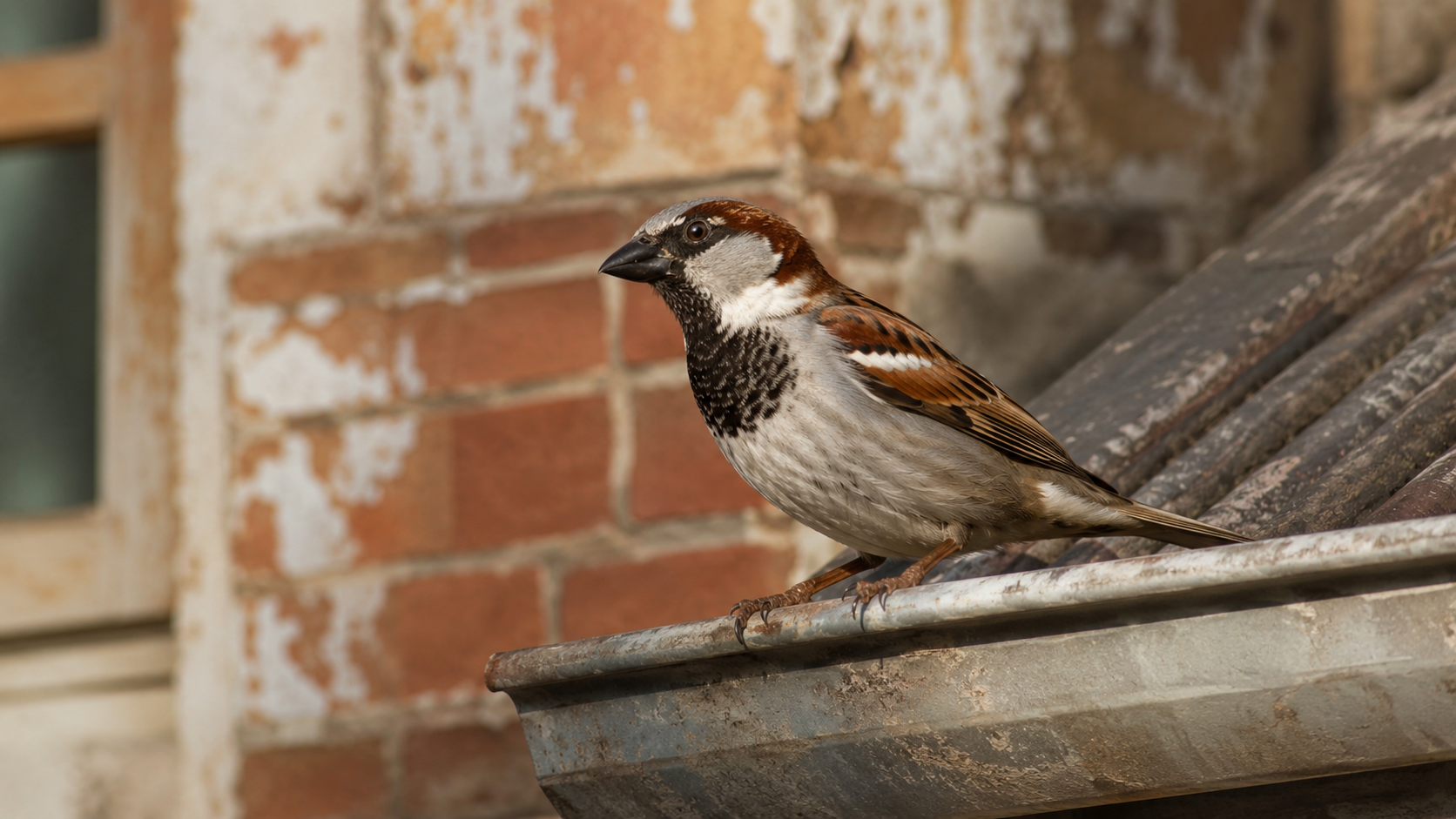
The house sparrow (Passer domesticus) is a small, stocky songbird with a wingspan of 21 to 25.5 cm and a body length of about 14 to 16 cm, weighing between roughly 24 and 39 grams. The male is the more distinctive of the sexes, with a grey crown, chestnut-brown nape and eye-stripe, and a bold black bib covering the throat and upper breast that broadens with age and appears to signal social status among males within a flock.
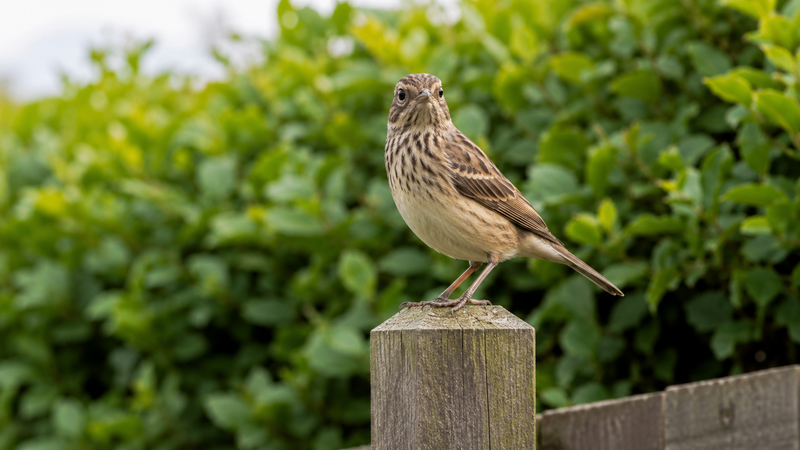
Females and juveniles are considerably plainer, with uniformly streaked brown upperparts and dull buff underparts, lacking any grey, chestnut, or black bib markings, which can make them relatively nondescript compared to the male and occasionally confusable with other streaky brown songbirds at a quick glance.
Range and habitat
The house sparrow has an enormous native range across Europe, Asia, and North Africa, and following extensive introduction — both deliberate and accidental, largely tied to human agriculture and settlement — it is now established on every continent except Antarctica, making it one of the most widely distributed wild bird species in the world. It is strongly resident, with populations remaining closely tied to a fixed area year-round rather than migrating.
The species is almost entirely commensal with humans, found overwhelmingly in and around towns, villages, and farms rather than natural, undisturbed habitat, and rarely occurs far from human structures and activity across most of its range, a close association that has shaped both its ecology and its long shared history with people.
Behavior and lifestyle
House sparrows feed mainly on seeds and grain, readily supplemented by human food scraps and, during the breeding season, a much higher proportion of insects needed to feed growing chicks. They are highly social, feeding, roosting, and even breeding in loose colonies, and are frequently seen dust-bathing communally in dry soil, a behavior thought to help maintain feather condition and reduce parasites.
Despite its historical status as one of the most common birds around human settlements across much of the world, the house sparrow has undergone striking and, in some cases, still poorly understood population declines in many Western European cities since the late 20th century, prompting significant conservation research attention even for a species still classified globally as Least Concern.
Breeding
House sparrows nest in cavities — commonly gaps in roofs, walls, and other building crevices — building an untidy, bulky nest of grass, feathers, and other soft material, and often nesting in loose colonies where several pairs use closely spaced cavities in the same building. The typical clutch is 3 to 5 eggs, incubated by both parents for 11 to 14 days. Chicks fledge at around 14 to 16 days old, and pairs frequently raise two or three broods across an extended breeding season where conditions allow.
Interesting facts
- Genetic and archaeological evidence suggests the house sparrow's close association with humans dates back many thousands of years, likely originating alongside the spread of early agriculture in the Middle East, making it one of the longest continuously human-associated wild birds known.
- The dramatic urban decline of house sparrows in cities such as London has prompted extensive citizen science monitoring efforts, since a bird once considered too common to study seriously became, within a few decades, a genuine conservation concern in parts of its range.
- Despite widespread declines in Western Europe, house sparrow populations remain large and stable across much of Asia, Africa, and other regions where the species was introduced, illustrating how conservation status can vary dramatically between different parts of a single species' enormous range.