Eurasian Hoopoe
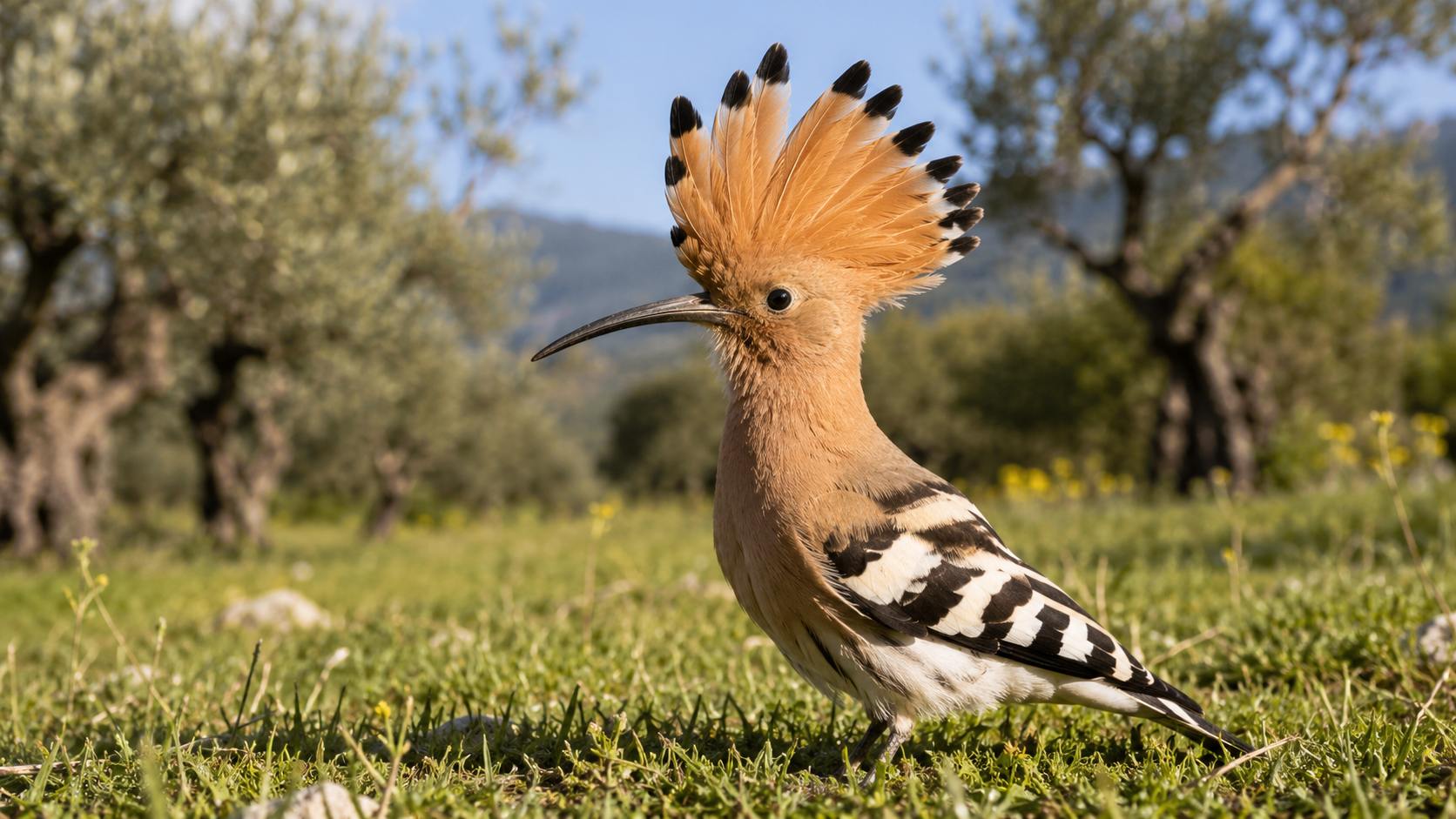
The Eurasian hoopoe (Upupa epops) is one of the most unmistakable birds in its range, a pinkish-orange bird with bold black-and-white striped wings and a tall, erectile crest, its long curved beak built for probing soil.
Key facts
- Latin name
- Upupa epops
- Family
- Upupidae (Hoopoes)
- Wingspan
- 44–48 cm
- Season
- April – September, wintering in sub-Saharan Africa
- Diet
- Insect larvae, especially mole cricket nymphs and beetle grubs, Large insects, including grasshoppers and crickets, Earthworms and other soil invertebrates
- Conservation status
- LCLeast Concern
Appearance
The Eurasian hoopoe (Upupa epops) is a medium-sized, strikingly patterned bird with a wingspan of 44 to 48 cm and a body length of about 25 to 32 cm, weighing between roughly 46 and 89 grams. Its head, neck, and breast are a warm pinkish-orange, topped by a tall, erectile crest of similarly colored feathers tipped in black and white, which the bird can fan open dramatically or hold flat depending on its mood and level of alertness.
The wings and tail show a bold, high-contrast pattern of black and white bars, particularly conspicuous in flight, when the hoopoe's broad, rounded wings and slow, floppy, almost butterfly-like wingbeats give it one of the most distinctive flight silhouettes of any bird in this atlas. The beak is long, thin, and gently downcurved, well suited to probing soil and other substrates for hidden invertebrate prey.
Range and habitat
The Eurasian hoopoe breeds across a broad range spanning southern and central Europe, much of Africa, and Asia, with European and Russian populations entirely migratory, present on the breeding grounds from roughly April to September and wintering across sub-Saharan Africa. Within Russia, the species reaches its northern range limit in the more southerly regions, generally absent from the coldest and most northerly parts of the country.
It favors open and semi-open habitats with short or sparse vegetation for foraging combined with cavities for nesting — orchards, parkland, farmland with scattered old trees, and warm, dry open country — and is generally more characteristic of southern and warmer parts of its European range than of colder northern regions.
Behavior and lifestyle
Hoopoes forage mainly on open ground, using the long, curved beak to probe soil, leaf litter, dung, and crevices for hidden invertebrate prey, particularly mole cricket nymphs and beetle grubs, along with larger surface-active insects such as grasshoppers and crickets when the opportunity arises. This specialized probing technique lets the species access food sources largely unavailable to birds with shorter, straighter beaks.
The species' most distinctive call — a soft, resonant, repeated "oop-oop-oop," which gives the bird both its English and scientific names — carries reasonably well and is often the first clue to a hoopoe's presence in an area. Despite its bold, conspicuous plumage, the hoopoe can be surprisingly easy to overlook while foraging quietly on the ground, becoming far more obvious once it takes flight and displays its bold black-and-white wing pattern.
Breeding
Hoopoes nest in cavities, including tree holes, wall crevices, and occasionally nest boxes, without adding substantial nesting material of their own. The typical clutch is 5 to 8 eggs, incubated solely by the female for 15 to 18 days, during which both the incubating female and, later, the growing chicks produce a foul-smelling secretion from a specialized preen gland, thought to help deter predators and parasites from the nest cavity. Chicks fledge at around 26 to 29 days old.
Interesting facts
- The hoopoe's distinctive defensive secretion has been studied for its antimicrobial properties, with some research suggesting it may also help protect the developing eggs and chicks from harmful bacteria within the enclosed, humid environment of a nest cavity.
- The species holds deep cultural and symbolic significance across numerous societies, including as the national bird of Israel and a recurring figure in Persian and other Middle Eastern literature and folklore.
- Hoopoe numbers and range in parts of northern Europe have shown some expansion in recent decades, a trend some researchers link to warming temperatures making previously marginal areas more suitable for the species.