Hoopoes (Upupidae)
A small family built around a single unmistakable species, the Eurasian hoopoe, known for its fan-like crest, curved probing beak, and unusual glandular nest defenses.
What makes Upupidae a family
Upupidae is one of the smaller bird families covered in this atlas, comprising the widespread Eurasian hoopoe alongside one or two additional, far more restricted island relatives found historically on Madagascar and Saint Helena, the latter now extinct. This makes the Eurasian hoopoe not just a single striking species but effectively the primary living representative of an entire distinct family, most closely related evolutionarily to hornbills and wood hoopoes, a grouping centered largely in Africa and southern Asia.
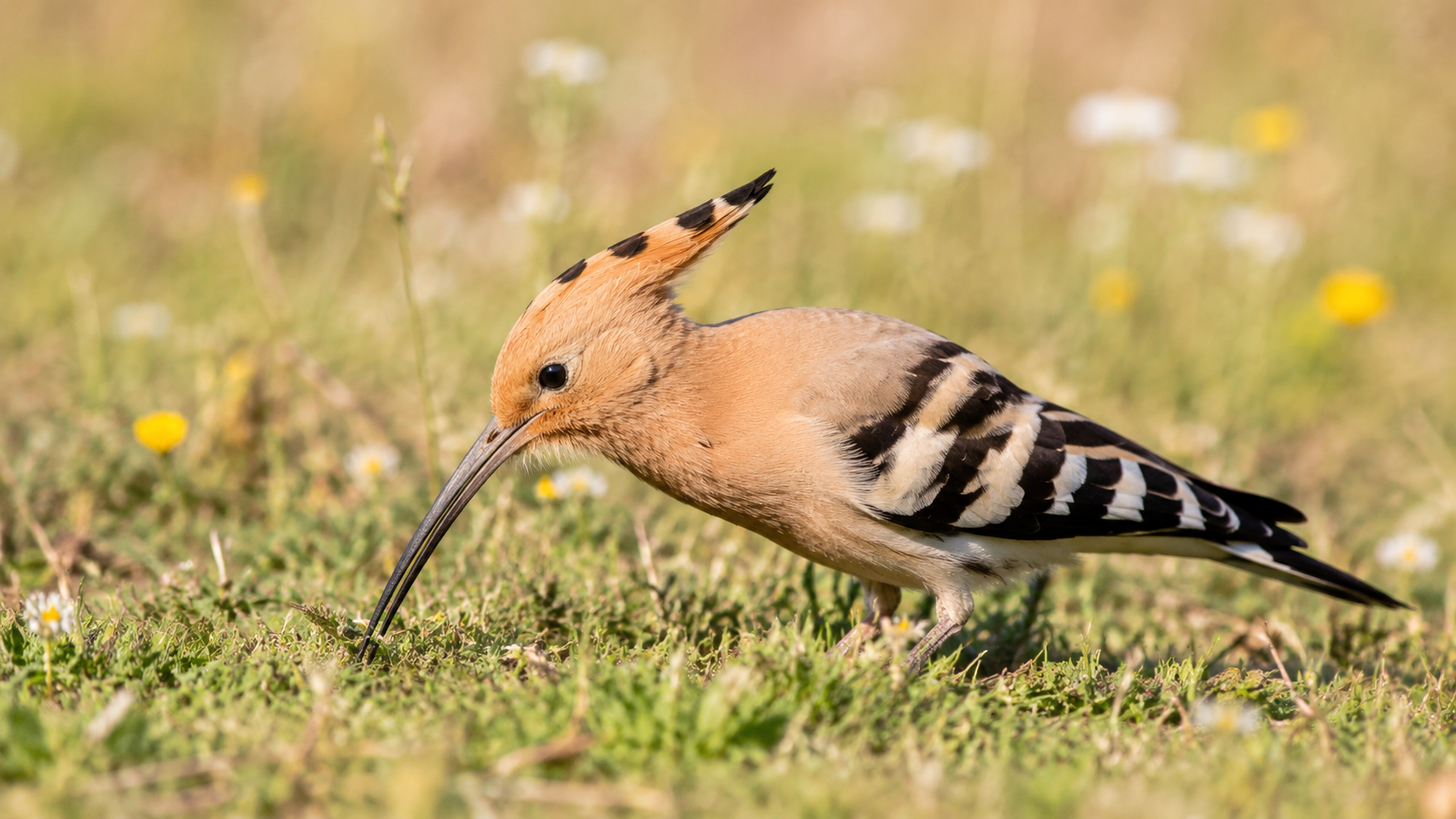
Physically, the family is defined by a distinctive combination of features seen clearly in the Eurasian hoopoe: a tall, fan-like, erectile crest, a long, thin, downcurved beak specialized for probing soil and other substrates, and bold, high-contrast black-and-white barring across the wings, visible especially in the species' slow, floppy, butterfly-like flight.
Distinctive traits across the family
Beyond its striking appearance, the hoopoe family is notable for an unusual defensive adaptation rarely found elsewhere among birds covered in this atlas: nesting females and their chicks produce a foul-smelling secretion from a specialized preen gland, spread on the plumage and thought to help deter predators and parasites from the enclosed nest cavity, a chemical rather than purely behavioral defense strategy.
Ground-based foraging, using the long curved beak to probe soil, dung, and crevices for hidden invertebrate prey, is another defining behavioral trait shared across the family, allowing access to food sources — particularly soil-dwelling insect larvae — that many shorter-beaked, surface-foraging birds cannot exploit as effectively.
Species in this family
This atlas currently covers the single member of Upupidae found across its covered regions: the Eurasian hoopoe (Upupa epops), an unmistakable pinkish-orange bird with a fan-like crest and bold black-and-white wings, and one of the most visually striking migrants to reach Europe and Russia each spring.
Where and when to watch this family
Warm, open habitats with short vegetation and scattered trees or structures offering nesting cavities — orchards, parkland, and farmland in the warmer parts of the atlas's covered regions — offer the best chance of encountering this family, and because the Eurasian hoopoe is a long-distance migrant from sub-Saharan Africa, it is present only from spring through late summer across most of its Eurasian range, with the species' resonant "oop-oop-oop" call often the easiest way to detect its presence in an area.