Common Gull
The common gull (Larus canus) is a medium-sized, clean-headed gull with a plain yellow-green bill, a familiar sight on rivers, lakes, and coasts mainly during spring and autumn passage.
Key facts
- Latin name
- Larus canus
- Family
- Laridae (Gulls)
- Wingspan
- 110–130 cm
- Season
- passage migrant, most visible in spring (April–May) and autumn (September–October)
- Diet
- Earthworms and soil invertebrates from wet or ploughed fields, Small fish, taken from the surface or by shallow plunge-diving, Aquatic and terrestrial insects, Food scraps and waste at harbors and refuse sites
- Conservation status
- LCLeast Concern
Appearance
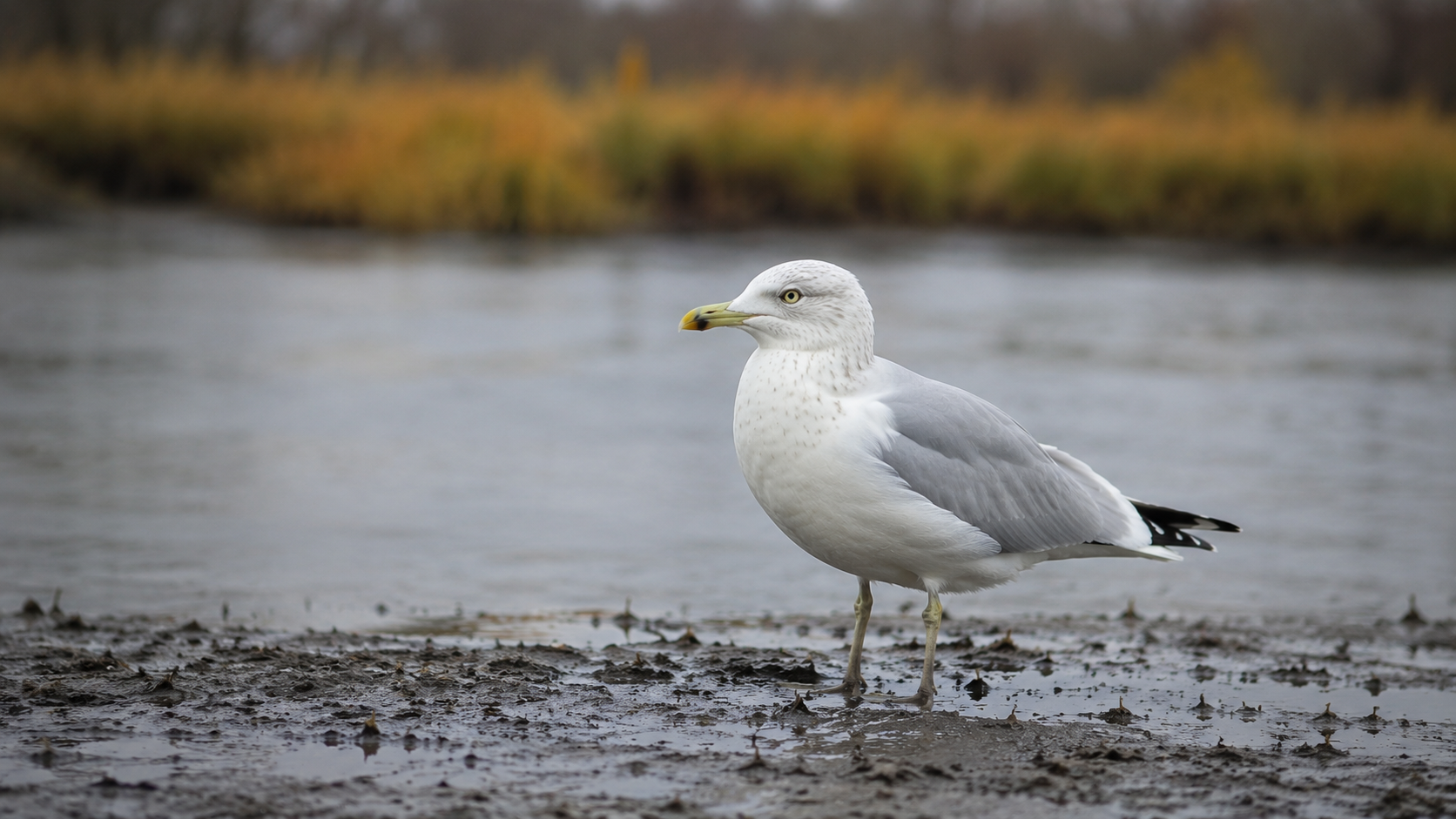
The common gull (Larus canus) is a medium-sized gull with a wingspan of 110–130 cm and a body length of 40–46 cm, weighing between roughly 300 and 550 grams, noticeably larger than the black-headed gull but distinctly smaller and more lightly built than the herring gull. Adults show a clean white head and underparts, a pale grey back and upperwings, and black wingtips marked with clear white spots, visible both at rest and in flight.
Its bill is slim and plain yellow-green, without the red spot present near the bill tip of several larger gull species, and its legs are a matching yellow-green to greenish-grey. Outside the breeding season the head becomes lightly streaked with grey-brown, giving a slightly smudged appearance that contrasts with the crisp white head of summer adults but remains distinct from the fully hooded look of the black-headed gull at any time of year.
Range and habitat
The common gull breeds across a broad northern range spanning Scandinavia, the Baltic region, and much of northern and central Russia through to the Far East, generally favoring lakes, rivers, coastal areas, and tundra or moorland pools further north. Across much of inland continental Europe and Russia south of its breeding range, however, the species is encountered mainly as a passage migrant rather than a breeding bird.
In these areas it is most visible during spring passage in April and May, as birds move north and east toward breeding grounds, and again during autumn passage in September and October, as birds return south and west toward milder wintering areas along ice-free coasts and larger inland waters, making it a bird most reliably looked for during these two seasonal windows.
Behavior and lifestyle
Common gulls are opportunistic feeders with a notably flexible diet, foraging on earthworms and other soil invertebrates in ploughed and wet fields, often walking steadily across open ground in loose flocks, sometimes alongside other gull and plover species disturbed food. On water, the species also readily takes small fish, either picked from the surface or captured with brief, shallow plunge-dives, along with aquatic and terrestrial insects.
Highly social, particularly outside the breeding season, common gulls often form sizeable mixed-species flocks at productive feeding sites such as harbors, refuse tips, and freshly ploughed farmland, and gather in communal roosts on open water or exposed shorelines overnight, a pattern shared broadly across many gull species in the family.
Breeding
Common gulls nest both colonially and in more scattered, loosely spaced pairs depending on local conditions, typically on the ground close to water, on small islands, or occasionally on elevated structures such as flat rooftops in some coastal towns. A typical clutch contains 2 to 3 eggs, incubated by both parents for around 23 to 28 days.
Chicks are semi-precocial, mobile within the nest area from an early age but remaining dependent on both parents for food and protection for several weeks, fledging at around 30 to 35 days. As with many colonial gulls, nesting birds defend the immediate nest area vigorously against predators and intruders, contributing to a degree of collective protection within denser colonies.
Interesting facts
- Despite its English name, the common gull is not necessarily the most numerous gull species across all of its range, with the name instead reflecting its former familiarity rather than a claim about relative abundance compared with other gulls.
- The species' habit of following tractors and gathering on freshly ploughed fields to feed on exposed earthworms is shared with several other gull species and is a reliable, easily observed foraging behavior during the agricultural season.
- Common gull populations across parts of their range show some sensitivity to changes in coastal and wetland habitat, though the species overall remains widespread and classified as Least Concern.