Common House Martin
The common house martin (Delichon urbicum) is a glossy blue-black aerial insect-hunter easily told from the barn swallow by its clean white rump, and famous for building enclosed mud nests under building eaves.
Key facts
- Latin name
- Delichon urbicum
- Wingspan
- 26–29 cm
- Season
- April – September, wintering in sub-Saharan Africa
- Diet
- Flying insects, caught entirely on the wing, Aphids and other small insects, often caught at height
- Conservation status
- LCLeast Concern
Appearance
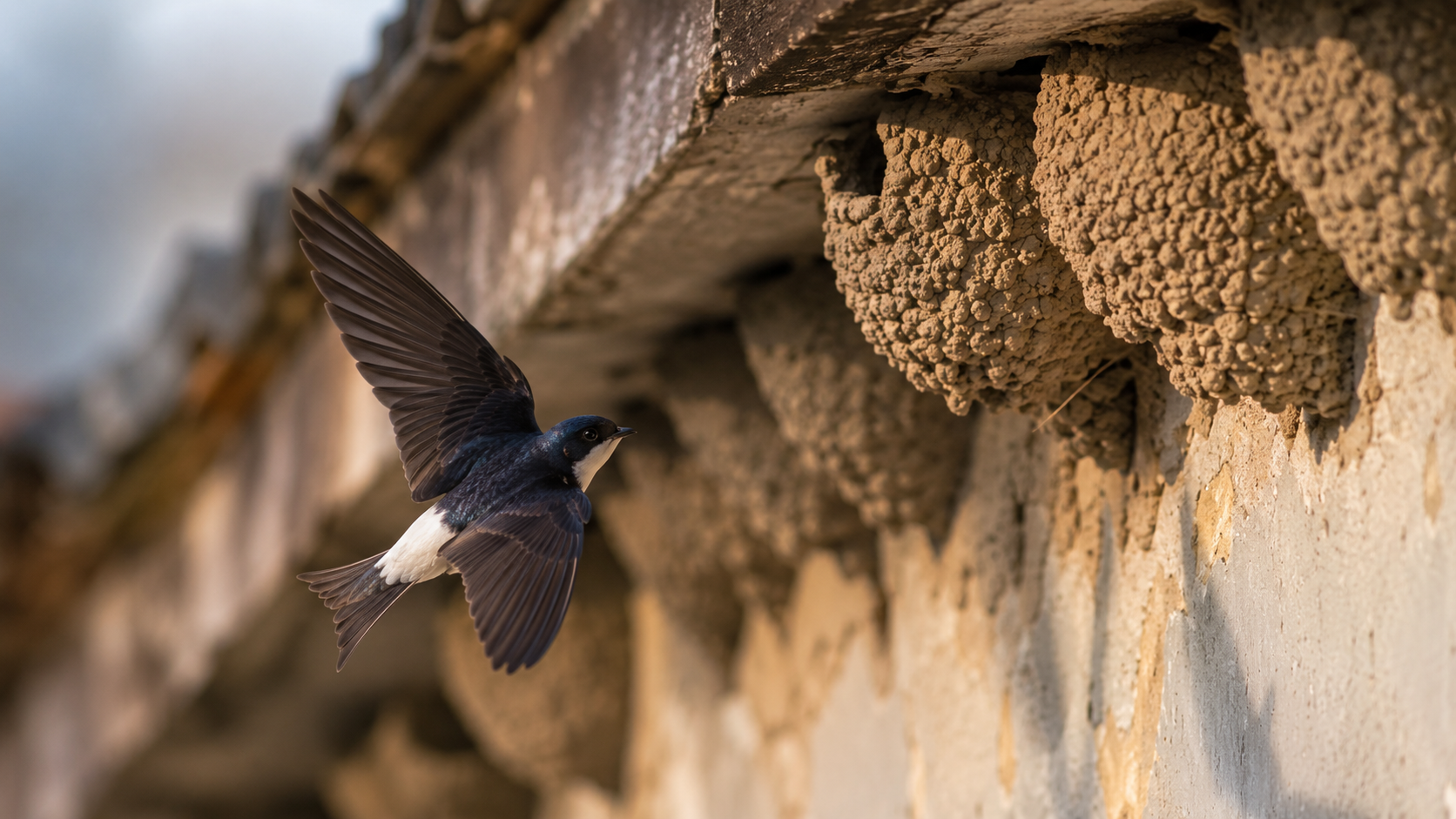
The common house martin (Delichon urbicum) is a compact, streamlined songbird with a wingspan of 26 to 29 cm and a body length of about 13 cm, weighing between roughly 15 and 21 grams. Its upperparts are a glossy, iridescent blue-black, similar in tone to the barn swallow's, but the house martin is immediately distinguished by a clean, solid white rump patch across the lower back, clearly visible in flight and one of the most reliable field marks among common European aerial insectivores.
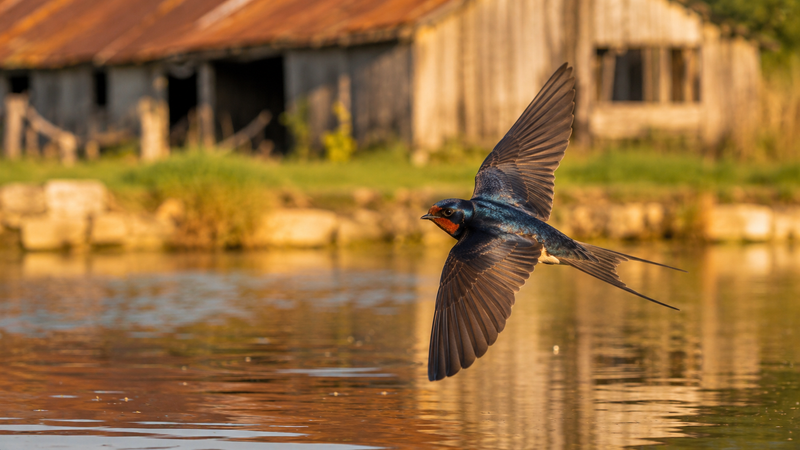
Underparts and the entire throat are pure white, without any of the rufous-red coloring shown by the barn swallow, and the tail, while forked, is noticeably shorter and less deeply cleft than the swallow's, entirely lacking the long, thin streamer feathers that extend well beyond the rest of the swallow's tail.
Range and habitat
The common house martin breeds across nearly all of Europe and extends through temperate Russia into parts of Central Asia. Populations are entirely migratory, present on the breeding grounds from roughly April to September and wintering across sub-Saharan Africa, following a long-distance migration broadly similar in scale to that of the barn swallow.
Despite the "house" in its name reflecting a strong historical association with human structures, the species originally nested on natural cliff faces, and while the great majority of the modern population now nests on buildings, some populations, particularly in more remote or mountainous parts of the range, still use natural rock faces, foraging over a wide range of open habitat, farmland, water bodies, and increasingly urban airspace wherever flying insects are abundant.
Behavior and lifestyle
House martins feed entirely on flying insects, caught on the wing during sustained, often quite high aerial foraging flights, sometimes ranging considerably higher above the ground than the more low-flying barn swallow, particularly when hunting aphids and other small insects concentrated at altitude on calm, warm days. Like other swallows and martins, house martins are highly sensitive to weather conditions that reduce flying insect activity, which can significantly affect breeding success during poor spells of cold or wet weather.
The species is markedly colonial compared to the more loosely social barn swallow, frequently nesting in dense clusters of a dozen or more nests built close together under the eaves of a single suitable building, a habit that likely offers advantages in shared predator vigilance and easier access to good local foraging conditions for the whole colony.
Breeding
House martins build an almost fully enclosed, dome-shaped nest of mud pellets, with only a small entrance hole near the top, fixed directly beneath an eave or overhanging roofline, considerably more elaborate in structure than the barn swallow's open mud cup. The typical clutch is 4 to 5 eggs, incubated by both parents for 14 to 16 days. Chicks fledge at around 22 to 32 days old, a notably longer nestling period than the barn swallow's, reflecting the more enclosed and better-protected nature of the nest itself.
Interesting facts
- House martin colonies on the same building have been documented persisting for many decades, with nests repaired and reused across generations of birds, making certain traditional colony sites locally well known and valued by residents.
- Because the species originally nested on natural cliffs before adapting so extensively to human buildings, occasional populations still using cliff faces in more remote parts of the range offer researchers a useful comparison point for studying how the species has adapted to an almost entirely human-associated nesting habit elsewhere.
- Like several other aerial insectivores, house martin populations have shown concerning declines in parts of Europe in recent decades, a trend researchers link to reduced flying insect abundance and the loss of suitable nest sites on modern buildings designed without the eave overhangs the species depends on.