Eurasian Tree Sparrow
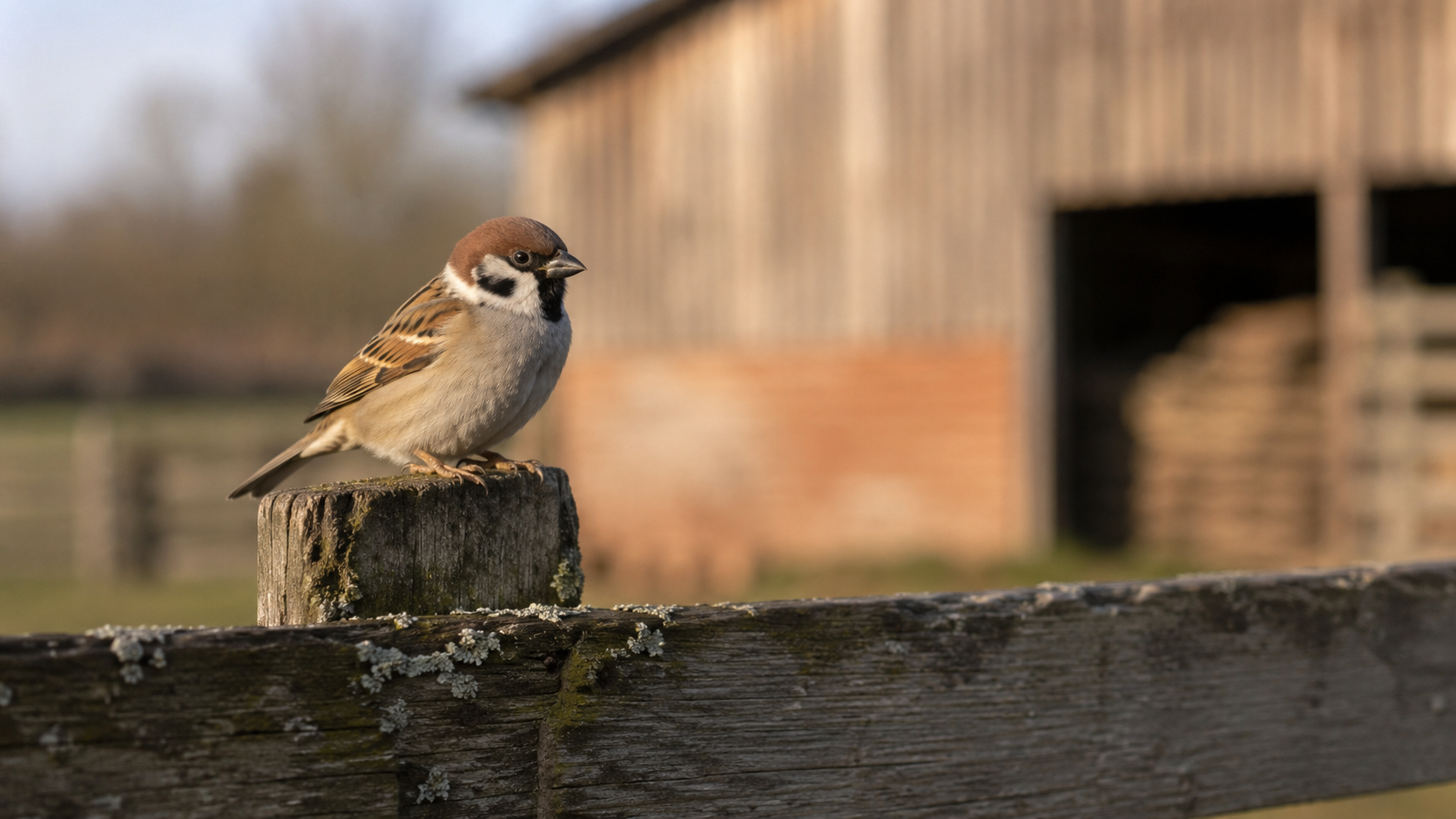
The Eurasian tree sparrow (Passer montanus) is a smaller, more rural relative of the house sparrow, told apart by its chestnut cap and neat black cheek spot, and both sexes look alike.
Key facts
- Latin name
- Passer montanus
- Wingspan
- 20–22 cm
- Season
- resident year-round
- Diet
- Seeds and grain, Insects, especially fed to nestlings, Buds and soft plant shoots, Garden feeder food, especially in winter
- Conservation status
- LCLeast Concern
Appearance
The Eurasian tree sparrow (Passer montanus) is a small, compact songbird with a wingspan of 20 to 22 cm and a body length of about 12.5 to 14 cm, weighing between roughly 19 and 25 grams — somewhat smaller and more slender overall than the closely related house sparrow. Its crown and nape are a rich, solid chestnut-brown, quite different from the grey crown of a male house sparrow, and its white cheeks are marked with a distinct, neat black spot that gives the species one of its most reliable field marks.
Unlike the house sparrow, the tree sparrow shows almost no plumage difference between the sexes — males and females look essentially identical, both sharing the chestnut cap, black cheek spot, and a comparatively small, neat black bib on the throat, considerably less extensive than the bib of a male house sparrow.
Range and habitat
The Eurasian tree sparrow has a broad range spanning most of temperate Europe and Asia, extending across nearly all of Russia south of the Arctic tundra and into East Asia, including much of China and Japan, where it fills a more urban niche than it typically does further west. It is strongly resident, remaining close to its breeding area year-round across virtually its entire range.
In much of Western and Central Europe it favors farmland, hedgerows, orchards, and villages more than dense city centers, occupying something of a complementary niche to the more urban-associated house sparrow, though this pattern shifts further east, where the tree sparrow is often the primary sparrow found even in large towns and cities.
Behavior and lifestyle
Tree sparrows feed mainly on seeds and grain, with a significant shift toward insects during the breeding season to meet the protein needs of growing chicks, and readily take advantage of garden feeders, particularly in winter when natural seed sources become scarcer. Like the house sparrow, the species is highly social, typically feeding and roosting in flocks and showing a strong preference for company over solitary foraging.
Where the two sparrow species occur together, tree sparrows are often somewhat more wary and quicker to flush than house sparrows, and the two rarely interbreed despite sharing similar habitat and behavior in many areas, remaining behaviorally and reproductively distinct species even where their ranges overlap extensively.
Breeding
Tree sparrows nest in cavities, including tree holes, cliff crevices, and building gaps, often nesting loosely colonially where suitable holes are clustered, such as under farm building eaves. The typical clutch is 4 to 6 eggs, incubated by both parents for 11 to 14 days. Chicks fledge at around 15 to 20 days old, and pairs commonly raise two or more broods across a single extended breeding season.
Interesting facts
- In parts of China, the Eurasian tree sparrow was targeted during a large-scale 1950s pest-control campaign aimed at reducing grain losses, an effort later linked to unintended ecological consequences after insect pest populations rose sharply once natural sparrow predation pressure on them was removed.
- Because tree sparrows show essentially no visible difference between the sexes, researchers studying the species in the field typically rely on behavioral cues or direct handling rather than plumage alone to determine an individual bird's sex.
- Population declines in parts of Western Europe have made the tree sparrow a species of increasing conservation research interest, despite its overall global population remaining large and its conservation status classified as Least Concern.