Old World Sparrows (Passeridae)
The Old World sparrow family: small, sociable, seed-eating birds closely tied to human settlement, from the familiar house sparrow to its quieter, farmland-favoring relative the tree sparrow.
What makes Passeridae a family
Passeridae, the Old World sparrow family, comprises around 40 species of small, sturdy, seed-eating songbirds native to Europe, Asia, and Africa, several of which — most notably the house sparrow — have since spread across most of the inhabited world through close association with human settlement and agriculture. Members share a stout, conical beak well suited to cracking seeds and grain, a compact, robust body, and a strongly social lifestyle, typically feeding, roosting, and breeding in flocks or loose colonies rather than as solitary or strictly paired individuals outside the breeding season.
Despite the shared common name, Old World sparrows are not closely related to the New World sparrows found across the Americas, which belong to an entirely different family that evolved separately; the resemblance in size, brownish streaked plumage, and general habits reflects convergent evolution toward a similar small-seed-eating lifestyle rather than a close evolutionary connection.
Distinctive traits across the family
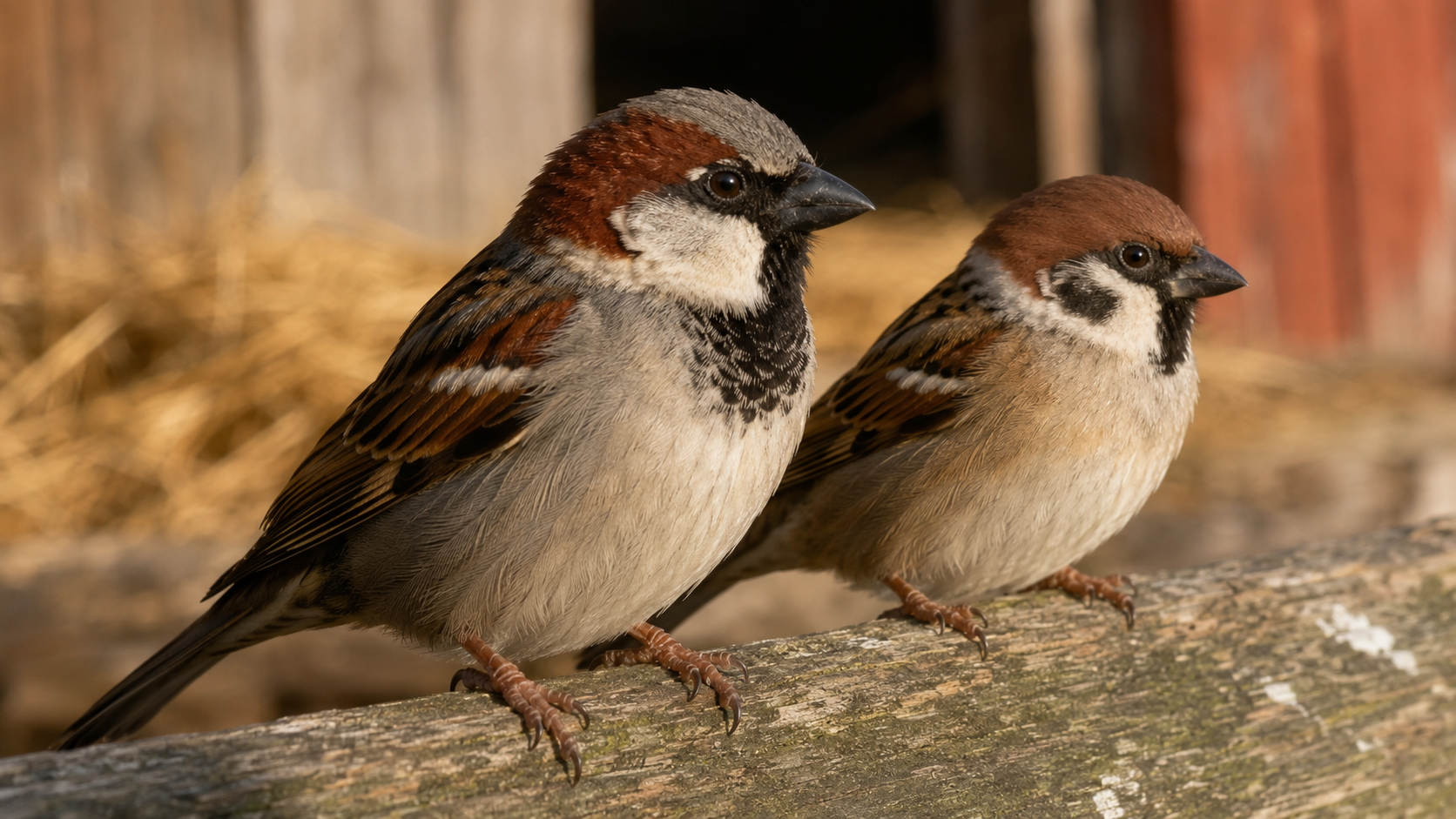
Head pattern provides the clearest way to distinguish between similar-looking Passeridae species: the house sparrow shows marked differences between the sexes, with males displaying a grey crown, chestnut nape, and broad black bib while females remain plain streaked brown, whereas the tree sparrow shows essentially no difference between sexes, both displaying a solid chestnut crown and a distinctive black cheek spot lacking in the house sparrow entirely.
Habitat association also varies meaningfully within the family even among closely related species: across much of Western Europe the house sparrow is the more thoroughly urban species while the tree sparrow favors farmland and villages, yet this pattern reverses in parts of East Asia, where the tree sparrow instead fills the primary urban sparrow niche.
Species in this family
This atlas currently covers two members of Passeridae: the house sparrow (Passer domesticus), one of the most widespread birds on Earth and a familiar companion of human settlement worldwide; and the Eurasian tree sparrow (Passer montanus), a smaller, more rural relative distinguished by its chestnut cap and black cheek spot. Further Passeridae species native to the atlas's covered regions will be added to the catalogue over time.
Where and when to watch this family
Because both species covered here are strongly resident and closely associated with human activity, sparrows can be found reliably year-round wherever suitable habitat exists — farmyards, villages, and, for the house sparrow especially, towns and cities across most of the atlas's covered regions. Unlike many songbird families, there is little seasonal pattern to watch for beyond the more conspicuous social flocking and dust-bathing behavior typical of both species outside the breeding season, making sparrows one of the more consistently observable bird families throughout the year.