White Wagtail
The white wagtail (Motacilla alba) is a slim, black-and-white bird known for its constantly bobbing tail, brisk running gait, and spectacular communal winter roosts that sometimes form in the middle of busy towns.
Key facts
- Latin name
- Motacilla alba
- Wingspan
- 25–30 cm
- Season
- resident in the west and south; migratory further north and east, present March – October
- Diet
- Flying insects, caught in short aerial sallies, Insects and other invertebrates gleaned from the ground, Small aquatic invertebrates near water
- Conservation status
- LCLeast Concern
Appearance
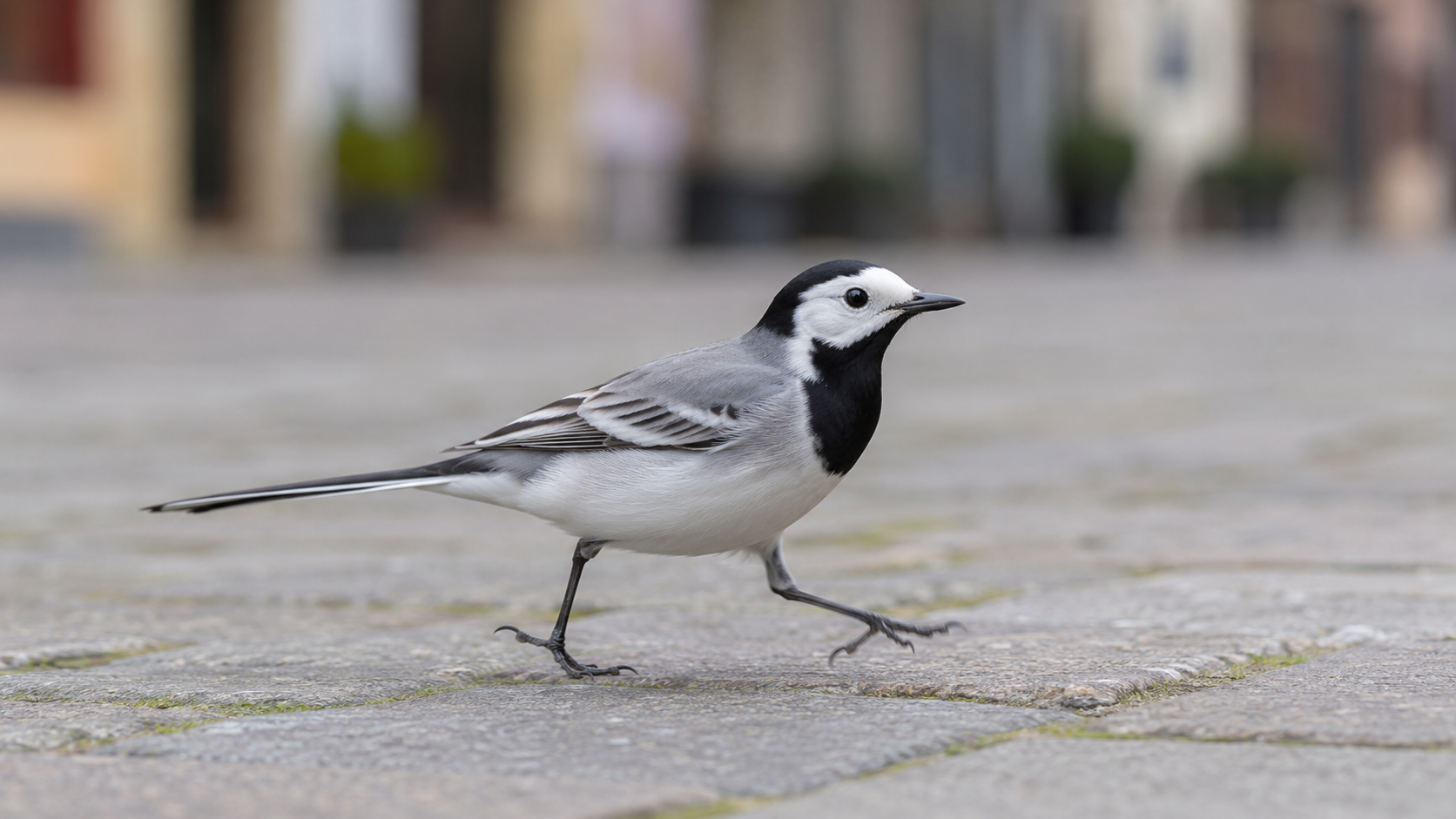
The white wagtail (Motacilla alba) is a slender, long-tailed songbird with a wingspan of 25 to 30 cm and a body length of about 18 cm, weighing between roughly 17 and 27 grams. In breeding plumage, the adult shows a clean white face, a black cap covering the crown and extending down the nape, and a bold black bib on the throat and upper breast, set against a pale grey back and white underparts — a crisp, high-contrast pattern that makes the species easy to identify at a glance.
Its most distinctive physical feature, however, is proportional rather than a matter of color: an unusually long tail relative to body size, which the bird bobs and wags almost constantly, whether standing, walking, or pausing briefly between short, brisk runs across open ground. Non-breeding adults and juveniles show a somewhat duller, more restricted black bib, but the overall black-white-grey pattern and long, wagging tail remain reliable identification clues year-round.
Range and habitat
The white wagtail has an extensive range spanning nearly all of Europe, much of Asia, and parts of North Africa, occurring across virtually the whole of Russia south of the high Arctic. Populations in the milder west and south of the range are largely resident, while birds breeding in colder parts of northern and eastern Russia are migratory, present from roughly March to October and wintering further south.
It is a highly adaptable species, found near water — riverbanks, lake shores, and wetland margins — but equally at home on open ground far from water, including farmland, parks, car parks, rooftops, and town squares, making it one of the more frequently encountered small birds in both rural and urban settings across its range.
Behavior and lifestyle
White wagtails forage mainly by walking or running briskly across open ground, snapping up insects and other small invertebrates either directly from the surface or with short aerial sallies to catch flying prey, a foraging style well suited to the open, often paved or short-grass habitats the species favors. Near water, aquatic invertebrates make up an additional part of the diet, particularly important during the breeding season.
Outside the breeding season, white wagtails are notably gregarious, often gathering in large communal winter roosts that in some towns and cities settle directly onto trees, buildings, or other structures in busy urban areas, likely drawn by the added warmth and relative safety such sites provide, sometimes producing striking gatherings of hundreds of birds converging at dusk in the middle of a town center.
Breeding
White wagtails nest in a wide variety of cavities and sheltered ledges, including holes in walls, riverbanks, and buildings, as well as more naturalistic sites among rocks or tree roots, building a cup nest of grass and other plant material. The typical clutch is 5 to 6 eggs, incubated mainly by the female for 12 to 14 days. Chicks fledge at around 14 to 15 days old, and pairs frequently raise two broods across an extended breeding season.
Interesting facts
- Large urban winter wagtail roosts have been documented reaching many hundreds of birds at a single site, occasionally prompting local news coverage or informal birdwatching gatherings simply to observe the spectacle of so many small birds converging on ordinary city infrastructure.
- The white wagtail's constant tail-bobbing behavior gives the species its common name across many European languages, reflecting how central this single, simple movement is to how people recognize and describe the bird.
- Several distinct subspecies of white wagtail are recognized across its huge range, differing subtly in the extent and pattern of black, white, and grey plumage, including the pied wagtail form found in the British Isles, which shows a notably darker back than continental European birds.