Eurasian Coot
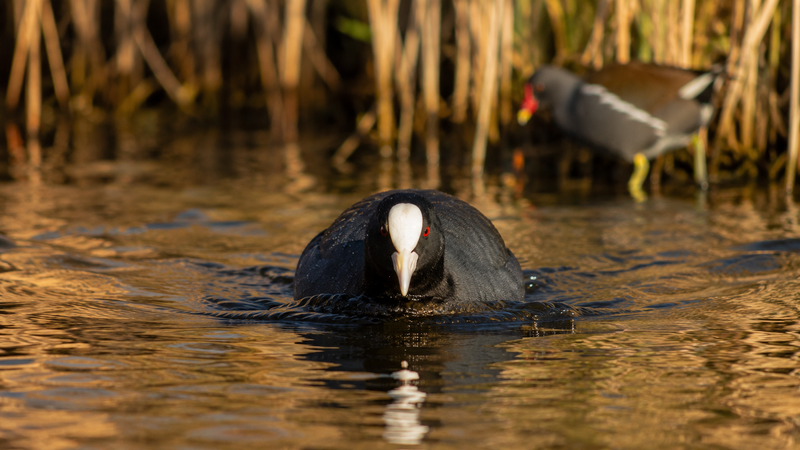
The Eurasian coot (Fulica atra) is a bold, aggressively territorial waterbird, recognized by its all-black plumage and bright white bill and frontal shield.
Key facts
- Latin name
- Fulica atra
- Wingspan
- 70–80 cm
- Season
- April – October in most of the range, with some birds wintering further south and west on unfrozen open water
- Diet
- Aquatic plants and algae, Seeds and shoots of waterside vegetation, Aquatic insects and their larvae, Small molluscs and crustaceans
- Conservation status
- LCLeast Concern
Appearance
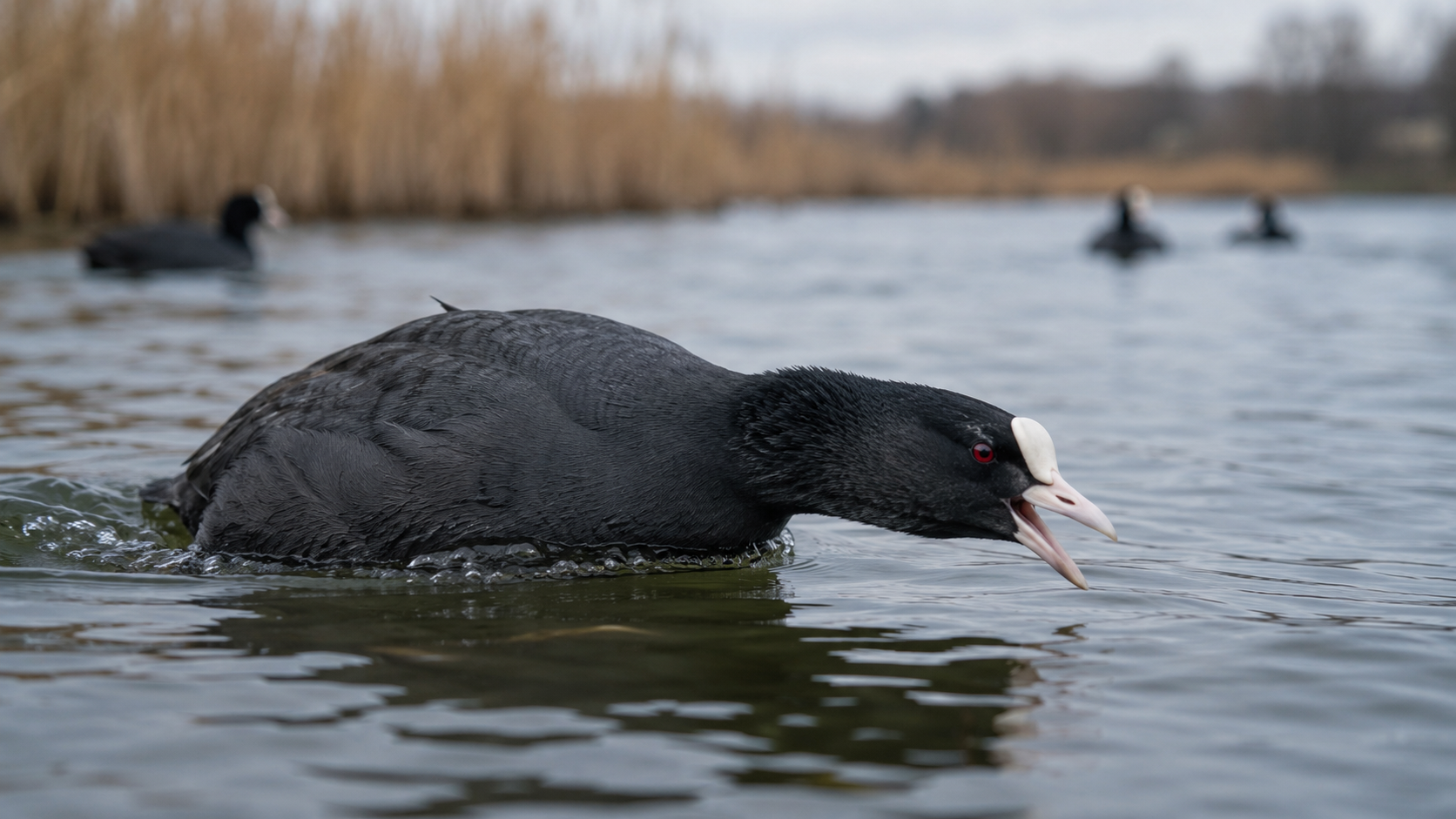
The Eurasian coot (Fulica atra) is a medium-sized waterbird with a wingspan of 70–80 cm and a body length of around 36–40 cm, entirely sooty black apart from a bright white bill and matching frontal shield across the forehead, a combination that makes it one of the most unmistakable waterbirds on any lake where it occurs. Its eyes are a striking deep red, visible at close range against the otherwise uniform black plumage.
Unlike most of its rail-family relatives, the coot has distinctively lobed toes rather than long, slender, unwebbed ones, an adaptation for swimming and diving that sets it apart from the more typically marsh-bound members of the family and allows it to spend far more time out on open water.
Range and habitat
The Eurasian coot is widespread across almost all of Europe and much of temperate Asia, including nearly the whole of Russia south of the Arctic tundra, favoring lakes, reservoirs, slow rivers, and other bodies of open freshwater with at least some fringing reed or emergent vegetation for nesting cover. It is considerably more tolerant of open water than most other rail-family species, often visible well out from shore even outside the breeding season.
Populations across the colder, more continental parts of the range are migratory, present from roughly April to October and moving to milder waters further south and west for winter, while populations across milder western and southern Europe tend to be largely resident, remaining year-round wherever open water stays available.
Behavior and lifestyle
Coots feed by diving for submerged aquatic plants and algae, as well as grazing on waterside vegetation and taking aquatic invertebrates, using their lobed toes to swim and dive with considerably more efficiency than most other rails. The species is notably aggressive and territorial, both during the breeding season, when pairs vigorously defend nesting space, and during winter, when large flocks form on open water and disputes over feeding space and social rank are frequent, often escalating into dramatic breast-to-breast sparring matches using the bird's strong feet.
Outside the breeding season, coots readily form large, conspicuous flocks on open lakes and reservoirs, a marked contrast to the more solitary, skulking habits typical of most other Rallidae species.
Breeding
Coots build a bulky nest of reed stems and other plant material at the water's edge or anchored among emergent vegetation, with a typical clutch of 6 to 9 eggs, incubated by both parents for around 21 to 24 days. Chicks are precocial and distinctively downy, with a bald reddish-orange head and bright orange-tipped down feathers around the neck, a striking contrast to the uniformly black adult plumage they will eventually develop.
Both parents feed and defend the chicks vigorously, and pairs will readily attack other coots, and occasionally other waterbird species, that approach too closely to their brood.
Interesting facts
- The size and brightness of a coot's white frontal shield has been shown in research to signal fighting ability and social status, influencing outcomes in the species' frequent territorial disputes.
- Despite appearing similar to ducks at a distance, coots are more closely related to cranes and rails than to any waterfowl species, a relationship reflected in their lobed rather than webbed toes.
- Large winter flocks of coots on reservoirs and lakes can number in the hundreds or even thousands in favorable habitat, making the species one of the most numerically dominant waterbirds on many wintering waters across its range.