Rails, Crakes, and Coots (Rallidae)
The rail family: laterally flattened marsh specialists built for slipping through dense reed beds, ranging from the secretive corncrake to the bold, aggressive Eurasian coot.
What makes Rallidae a family
Rallidae, the rail family, comprises around 150 species worldwide, including rails, crakes, gallinules, moorhens, and coots. The family's defining physical trait is a body laterally compressed from side to side — the source of the saying "thin as a rail" — allowing most species to slip easily through dense stands of reed, sedge, or long grass that would obstruct a more conventionally rounded waterbird. Wings are typically short and rounded, giving many species a weak, fluttering flight despite some undertaking substantial long-distance migrations.
Diet across the family is broadly omnivorous, including aquatic and terrestrial invertebrates, plant material, seeds, and occasionally small vertebrates, with the precise balance varying considerably between the family's more wetland-bound species and its handful of dry-grassland specialists.
Distinctive traits across the family
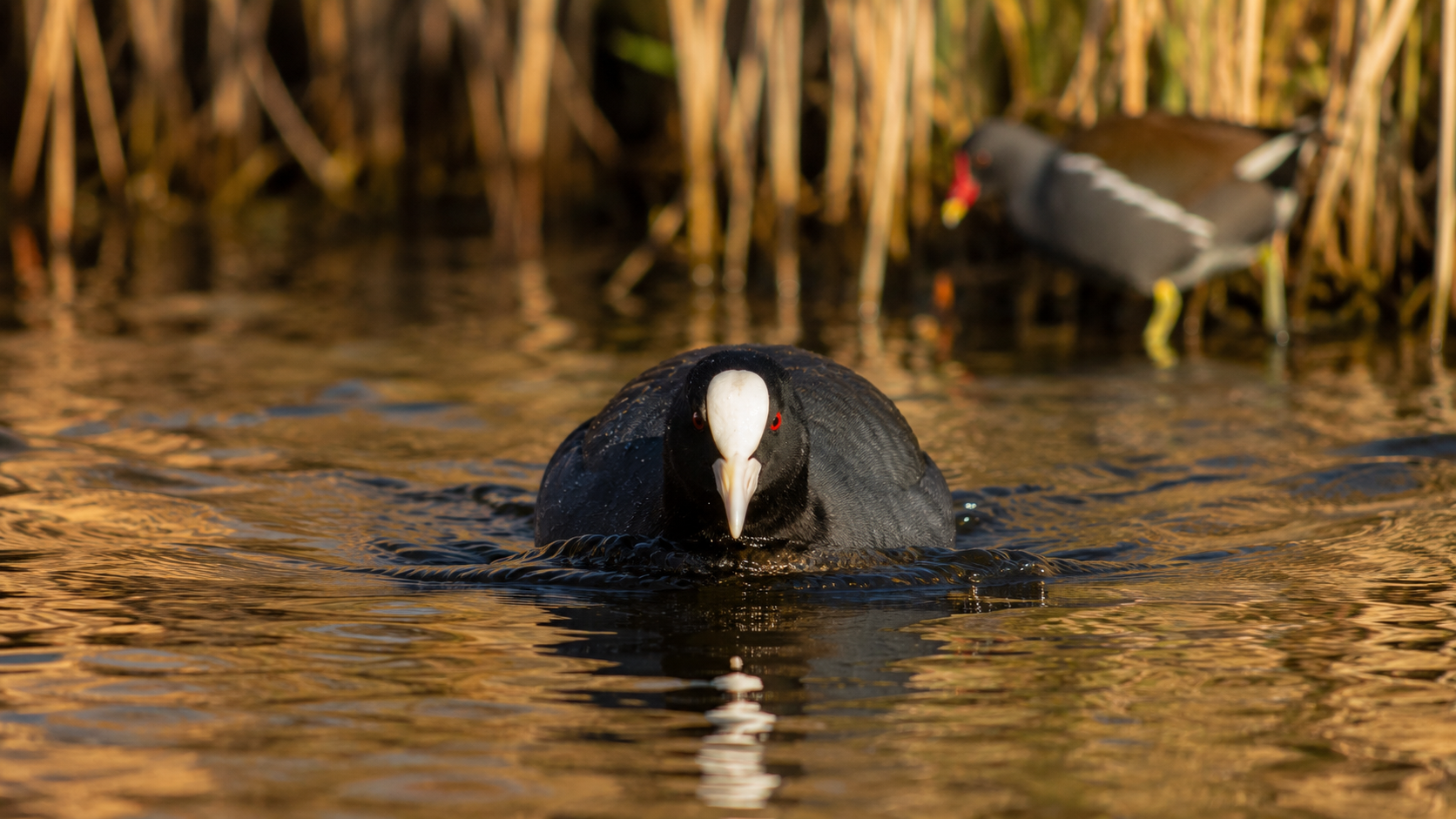
Most Rallidae species are highly secretive, spending the overwhelming majority of their time concealed within dense vegetation and relying on distinctive, often loud or harsh calls rather than visual display to communicate, making voice the primary means of detecting many species in the field. The Eurasian coot stands out as a partial exception, spending much of its time on open water and displaying bold, aggressive territorial behavior rather than the skulking habits typical of the wider family.
Toe structure varies meaningfully across the family: coots have distinctive lobed toes that aid swimming and walking across soft mud, while most rails and crakes have long, slender, unlobed toes suited to walking across floating vegetation and dense marsh growth rather than swimming.
Species in this family
This atlas currently covers three members of Rallidae: the Eurasian coot (Fulica atra), a bold, aggressive, and highly visible species recognized by its all-black plumage and white bill and frontal shield, often forming large flocks on open water outside the breeding season; the corncrake (Crex crex), a notably secretive dry-grassland specialist known for its rasping, far-carrying "crex-crex" call and its status as a species of serious international conservation concern; and the common moorhen (Gallinula chloropus), a more retiring relative of the coot recognized by its red frontal shield and white flank stripe, typically found skulking along reed-fringed pond and lake margins. Further Rallidae species will be added to the catalogue over time.
Where and when to watch this family
Wetland-associated rails, moorhens, and coots are best looked for along reed-fringed lake and pond margins, with coots often the most conspicuous, forming visible rafts on open water outside the breeding season from autumn through winter. The corncrake is a very different proposition, best listened for at night in hay meadows and rough grassland during May and June, when males call persistently to establish territory, since the species is rarely seen well even where present. Spring and early summer generally offer the best chance of detecting the family's more secretive members, as breeding activity brings increased calling even from species that remain almost entirely hidden the rest of the year.