Common Swift
The common swift (Apus apus) is a scythe-winged aerial specialist that spends almost its entire life airborne, feeding, sleeping, and even mating on the wing, only landing to nest.
Key facts
- Latin name
- Apus apus
- Family
- Apodidae (Swifts)
- Wingspan
- 38–40 cm
- Season
- late April – early August, wintering in sub-Saharan Africa
- Diet
- Flying insects and airborne spiders, caught entirely on the wing, Aerial plankton, gathered at high altitude ahead of poor weather
- Conservation status
- LCLeast Concern
Appearance
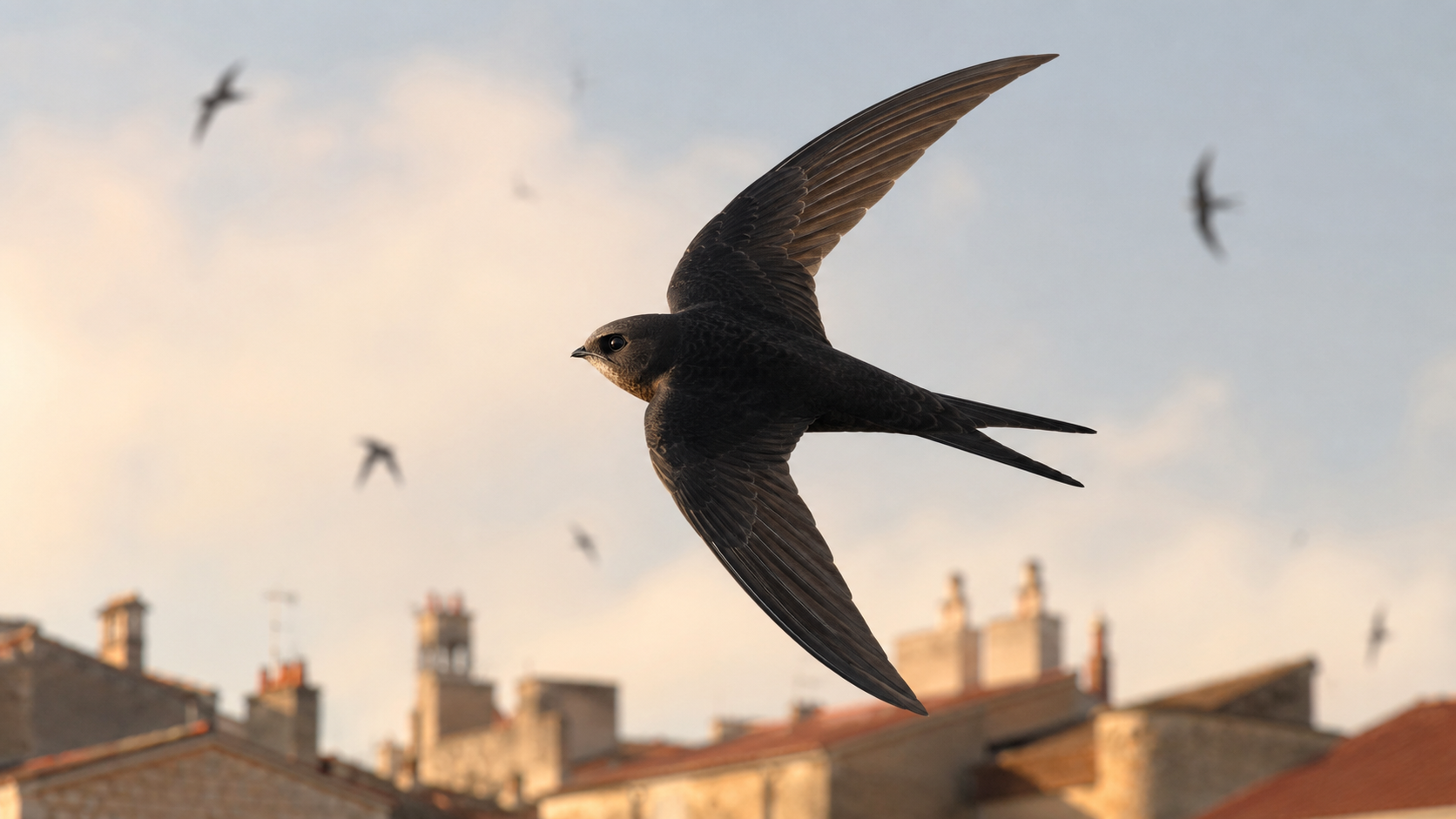
The common swift (Apus apus) is a highly aerodynamic songbird-like bird with a wingspan of 38 to 40 cm and a body length of about 16 to 17 cm, weighing between roughly 31 and 56 grams. Its plumage is an almost uniform sooty blackish-brown, appearing entirely black in flight against the sky, with only a small, pale throat patch breaking the otherwise dark coloring and often visible only at close range or in good light.
The silhouette is the species' most distinctive feature: long, narrow, crescent- or scythe-shaped wings swept sharply backward, paired with a short, shallowly forked tail, giving the swift an anchor- or boomerang-like shape in flight that is instantly recognizable once learned, quite different from the straighter-winged silhouette of swallows and martins it is sometimes confused with at a glance.
Range and habitat
The common swift breeds across nearly all of Europe and extends through temperate Russia into western Siberia. The species is entirely migratory, present on the breeding grounds only briefly, from roughly late April to early August, before departing on a long journey to winter across sub-Saharan Africa — one of the shortest breeding-season presences of any common European bird covered in this atlas, reflecting the extraordinary degree to which the species' life is spent airborne rather than tied to any fixed territory.
It nests almost exclusively in cavities, historically in cliff crevices and hollow trees but now overwhelmingly in gaps and holes in buildings, particularly older structures with eaves, roof spaces, and similar openings, and forages over an enormous range of open airspace above towns, farmland, water, and open country wherever flying insects are abundant.
Behavior and lifestyle
Swifts feed entirely on flying insects and airborne spiders, caught directly on the wing during sustained, extremely fast and agile flight, often at considerable altitude, and are known to actively track and fly around approaching bad weather systems to remain within airspace still holding sufficient insect prey. Remarkably, the species carries out nearly every part of its life cycle in flight outside the brief nesting period: feeding, drinking by skimming the surface of water bodies, collecting nesting material blown into the air, and even resting through brief periods of partial sleep while gliding at altitude.
A swift's legs are proportionally tiny and weak, adapted almost solely for clinging to a vertical surface near a nest entrance rather than for walking or perching, meaning the species essentially never lands on flat, open ground by choice and can struggle seriously to take off again if it ever ends up grounded there. Screaming parties of swifts chasing each other at high speed around rooftops on summer evenings are one of the species' most recognizable and widely enjoyed behaviors across much of urban Europe.
Breeding
Swifts nest in cavities, typically gaps under roof tiles, eaves, or similar sheltered openings in buildings, building a simple nest from feathers and other airborne material caught in flight and bound together with saliva. The typical clutch is 2 to 3 eggs, incubated by both parents for 19 to 25 days, a period that can extend noticeably longer during cold, wet weather when parents must range further to find sufficient insect food. Chicks fledge at a highly variable 37 to 56 days old depending on weather and food availability, and young swifts are capable of entering a controlled state of torpor to conserve energy during extended poor weather when parents cannot deliver enough food.
Interesting facts
- Tracking studies using tiny geolocator devices have shown that fledgling common swifts can remain continuously airborne for up to ten months at a stretch after leaving the nest, not touching any solid surface again until returning to breed roughly a year later.
- Despite strong superficial similarity in shape and lifestyle to swallows and martins, genetic evidence places swifts far closer to hummingbirds on the bird family tree, making the resemblance a striking case of convergent evolution rather than close relatedness.
- Loss of suitable nesting cavities in modern building renovation has become a significant conservation concern for common swifts across parts of Europe, prompting some countries to promote the installation of dedicated swift nest boxes and bricks in new and renovated buildings.