Swifts (Apodidae)
The swift family: extreme aerial specialists that spend nearly their entire lives in flight, closer in ancestry to hummingbirds than to the swallows they superficially resemble.
What makes Apodidae a family
Apodidae, the swift family, comprises around 100 species found across most of the world, unified by an extraordinarily thorough adaptation to life in the air. Members share long, narrow, backward-swept wings built for fast, sustained, highly efficient flight, and extremely small, weak legs and feet — a trait so pronounced that the family's scientific name derives from a Greek word meaning "without feet," reflecting how completely swifts have specialized away from any need to walk, perch, or stand on flat ground.
Despite occupying a very similar ecological role to swallows and martins, and showing a broadly similar wing shape and aerial hunting style, swifts belong to an entirely separate branch of the bird family tree — genetic evidence places them far closer to hummingbirds than to any songbird, making the resemblance to swallows a striking example of convergent evolution rather than shared ancestry.
Distinctive traits across the family
Swifts take aerial specialization further than almost any other bird family, with documented behavior including feeding, drinking, gathering nest material, and resting through brief periods of partial sleep, all carried out while airborne. Some species, including the common swift, are known from tracking studies to remain continuously in flight for months at a time outside the breeding season, touching a solid surface only when returning to nest.
This extreme lifestyle comes with a corresponding vulnerability: because swift legs are so poorly adapted for anything beyond clinging to a vertical surface, a swift that ends up grounded on flat, open terrain can struggle seriously to become airborne again, a real hazard for a family that otherwise thrives specifically by avoiding solid ground almost entirely.
Species in this family
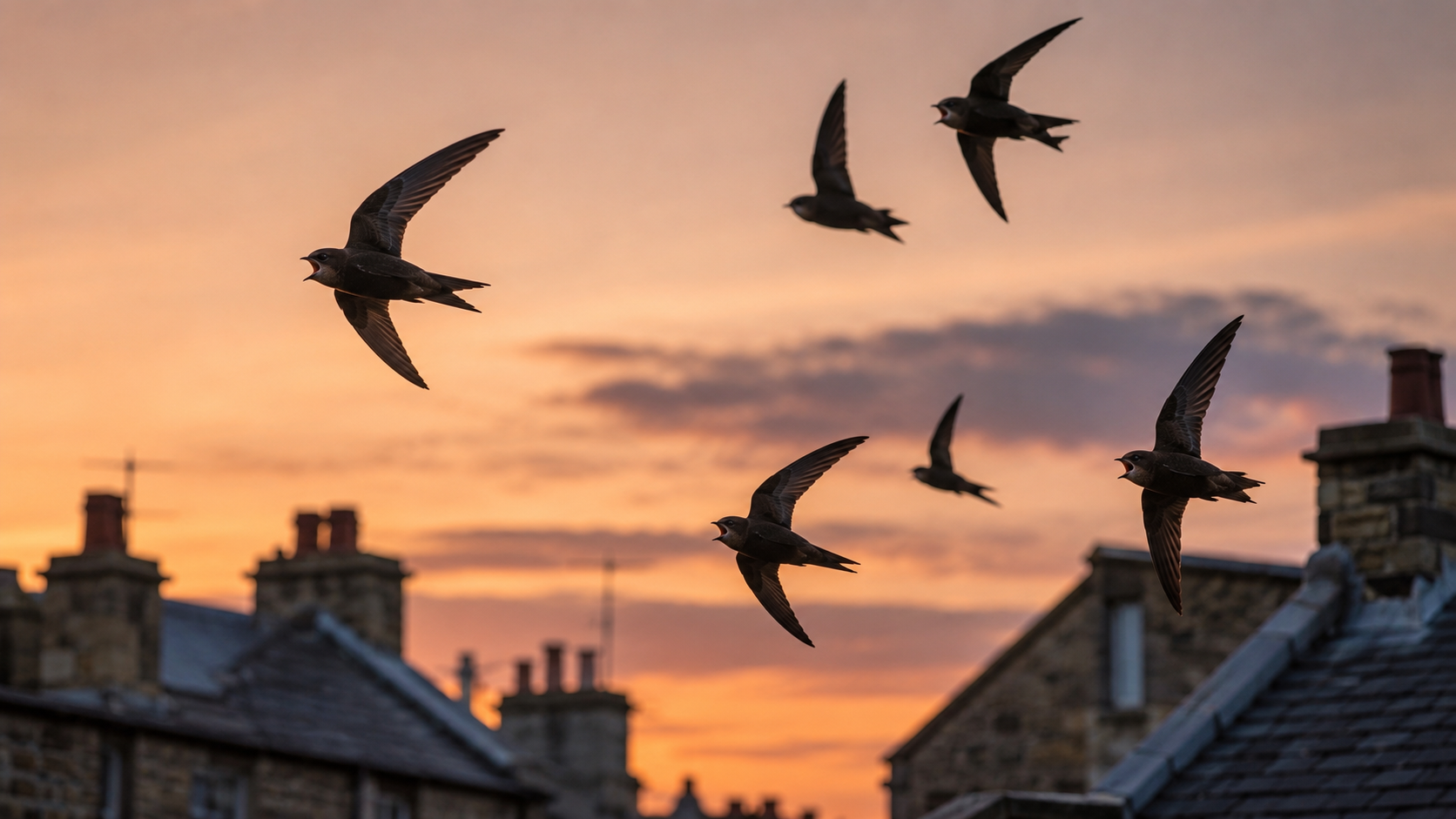
This atlas currently covers one member of Apodidae: the common swift (Apus apus), famous for spending nearly its entire life airborne and for its screaming aerial display flights around rooftops on summer evenings. Further Apodidae species native to the atlas's covered regions will be added to the catalogue over time.
Where and when to watch this family
Towns and cities with older buildings offering suitable nesting cavities, along with open airspace above farmland and water where flying insects concentrate, are the best places to look for swifts, though because the family spends so little time near the ground, sightings are almost always of birds moving fast overhead rather than perched or resting. Given how brief the common swift's presence on its breeding grounds is, summer offers a narrow but reliable window in which to see and hear this family's characteristic high-speed screaming flight displays around rooftops at dusk.