Old World Orioles (Oriolidae)
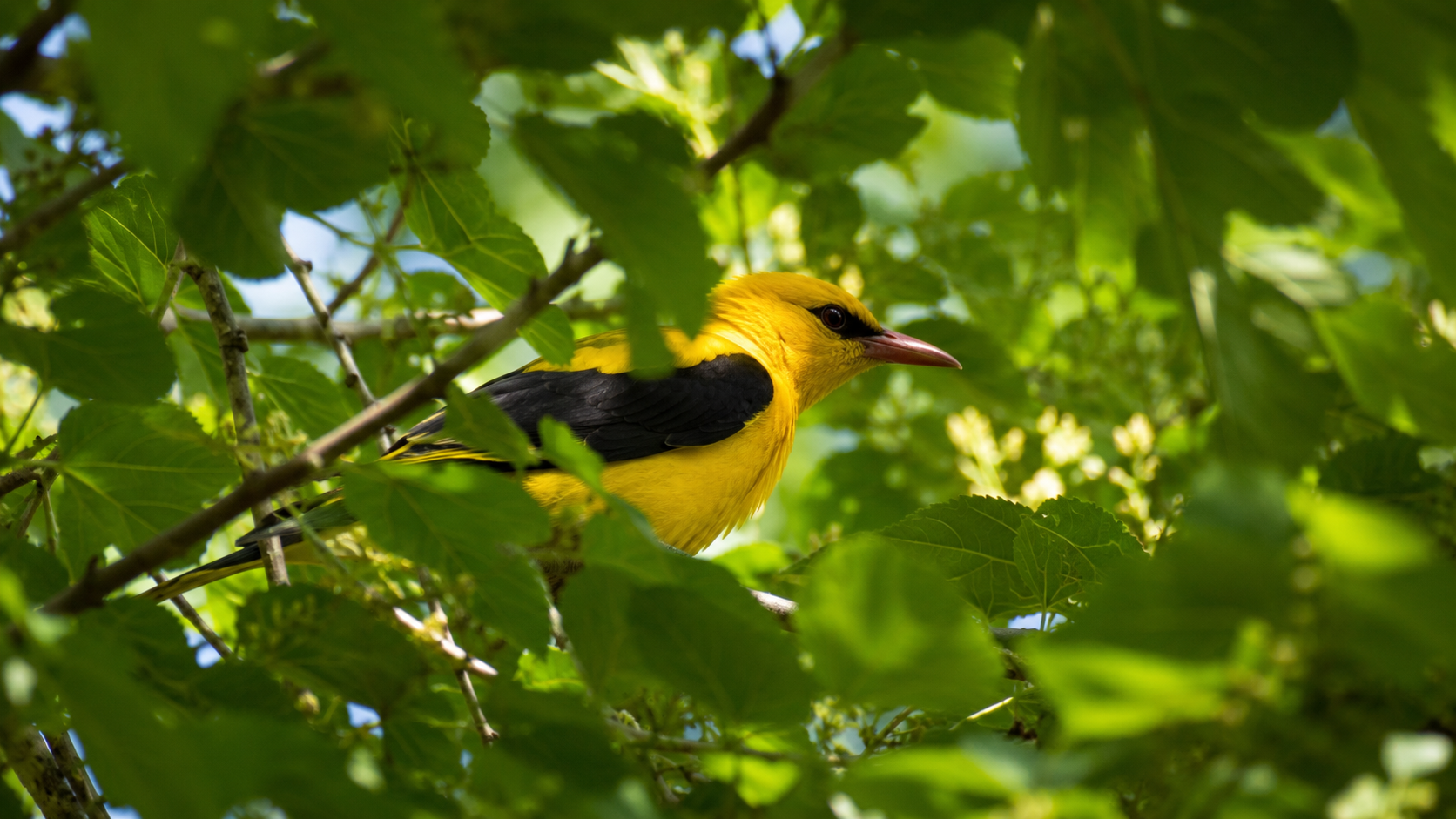
A family of brilliantly colored but famously shy canopy songbirds, represented in Europe by the golden oriole, a bird more often identified by its fluting song than by sight.
What makes Oriolidae a family
Oriolidae, the Old World oriole family, comprises around 30 species found across Europe, Asia, Africa, and Australasia, sharing a fairly robust, medium-sized songbird build, a strong, slightly downcurved beak suited to a mixed diet of insects and fruit, and a strong behavioral preference for remaining high within dense forest or woodland canopy rather than venturing onto more open, exposed perches. This shared canopy-dwelling habit is arguably as central to the family's identity as any specific plumage pattern, shaping how difficult most oriole species are to observe directly despite often striking coloration.
Sexual dimorphism is pronounced in several family members, including the golden oriole, with males typically displaying much bolder, higher-contrast plumage than the considerably duller females, a pattern that likely balances the different pressures of territorial display against the need for effective camouflage while incubating eggs and raising young largely out of view within dense foliage.
Distinctive traits across the family
Despite the shared common name, Oriolidae is not closely related to the New World orioles found across the Americas, which belong to an entirely separate family more closely related to blackbirds — a naming coincidence based on superficial resemblance in coloring rather than shared ancestry, similar to other cases across bird taxonomy where common names have converged independently of underlying evolutionary relationships.
Vocal ability plays an outsized role in how most Old World orioles are actually detected in the field, since their combination of shy habits and dense canopy preference means that a rich, distinctive song, as in the golden oriole's fluting call, is typically far more useful for confirming a bird's presence than any direct visual sighting, even for a species with plumage as bold as the male golden oriole's.
Species in this family
This atlas currently covers one member of Oriolidae: the Eurasian golden oriole (Oriolus oriolus), one of the most brilliantly colored songbirds in Europe despite being far more often heard than seen. Further Oriolidae species native to the atlas's covered regions will be added to the catalogue over time.
Where and when to watch this family
Mature deciduous woodland with a tall, dense canopy, particularly poplar stands near rivers and wetlands, offers the best chance of encountering this family, and because the golden oriole is a long-distance migrant, it is present in Europe and Russia only from late spring through summer. Patient listening for the species' distinctive fluting call, rather than active searching by sight, remains the most reliable way to confirm this family's presence in a given area of suitable habitat.